Welcome! I really enjoy exchanging information with people and love that this blog helps with that. I consider much of my research as a work in progress, so please let me know if you have conflicting information. Some of the surnames I'm researching:

Many old Cape families including Kelley, Eldredge/idge, Howes, Baker, Mayo, Bangs, Snow, Chase, Ryder/Rider, Freeman, Cole, Sears, Wixon, Nickerson.
Many old Plymouth County families including Washburn, Bumpus, Lucas, Cobb, Benson.
Johnson (England to MA)
Corey (Correia?) (Azores to MA)
Booth, Jones, Taylor, Heatherington (N. Ireland to Quebec)
O'Connor (Ireland to MA)
My male Mayflower ancestors (only first two have been submitted/approved by the Mayflower Society):
Francis Cooke, William Brewster, George Soule, Isaac Allerton, John Billington, Richard Warren, Peter Browne, Francis Eaton, Samuel Fuller, James Chilton, John Tilley, Stephen Hopkins, and John Howland.
Female Mayflower ancestors: Mary Norris Allerton, Eleanor Billington, Mary Brewster, Mrs. James Chilton, Sarah Eaton, and Joan Hurst Tilley.
Child Mayflower ancestors: Giles Hopkins, (possibly) Constance Hopkins, Mary Allerton, Francis Billington, Love Brewster, Mary Chilton, Samuel Eaton, and Elizabeth Tilley.
Showing posts with label Mayflower. Show all posts

Monday, July 12, 2021

Aptuxcet Trading Post, Bourne, Massachusetts


I’ve long wanted to visit Aptuxcet Trading Post and finally did so this weekend. It’s always intrigued me as it’s a replica of the Pilgrim’s trading post, believed to be built on the post’s original foundation. The Bourne Historical Society does a wonderful job of keeping the story of this aspect of the Pilgrim’s story alive.


My 11th great-grandfather and Mayflower passenger John Howland (ca 1592-1672) would have been involved at the trading post since he must have gained experience there before 1634 when he was in put in charge of the Pilgrim’s trading post on the Kennebec River (now Augusta, Maine). I hope to learn more about other Pilgrim ancestors who would have been involved at Aptuxcet. I’m guessing my ancestor and Mayflower passenger Isaac Allerton would have had dealings there as he was involved at the trading post in Machias, Maine, a fish station at Marblehead and was a constant wheeler-dealer.

Later the Pilgrims closed the post and in 1652 sold the land to my 10th great-grandfather Thomas Burgess (ca 1603-1685) of Sandwich. Thomas was allowed to take herring from the river. In 1663 he deeded the land to his son-in-law Ezra Perry (ca 1625-1689), my 10th great-grandfather. Ezra lived on the land with his family and he and his brothers traded at Herring River.

We had an excellent docent, Beth, who gave us such a nice picture of what life was like in the 1620s at the trading post. It is believed that there were typically two men from Plymouth Colony working at the post, sleeping in the upper level, quite possibly indentured servants. She said beer was always on hand for traders to imbibe while they negotiated. The post has one room set up as where the trading, meal preparation, beer brewing and drinking would have occurred and the other room is a tribute to the Wampanoag people. The tool the Native’s used to make wampum from Quahog shells to use as currency is just remarkable.


In addition to the Trading Post building, the property includes the 19th century Gray Gables Railroad Station, which was President Grover Cleveland’s private station used when he visited his vacation home in Bourne, the Joseph Jefferson Windmill built as an art studio for the actor and currently serves as an art gallery, a 19th century saltworks replica, gardens, and schooner replicas. The windmill houses a unique pedal-powered carousel, but it isn't operating because of COVID-19.

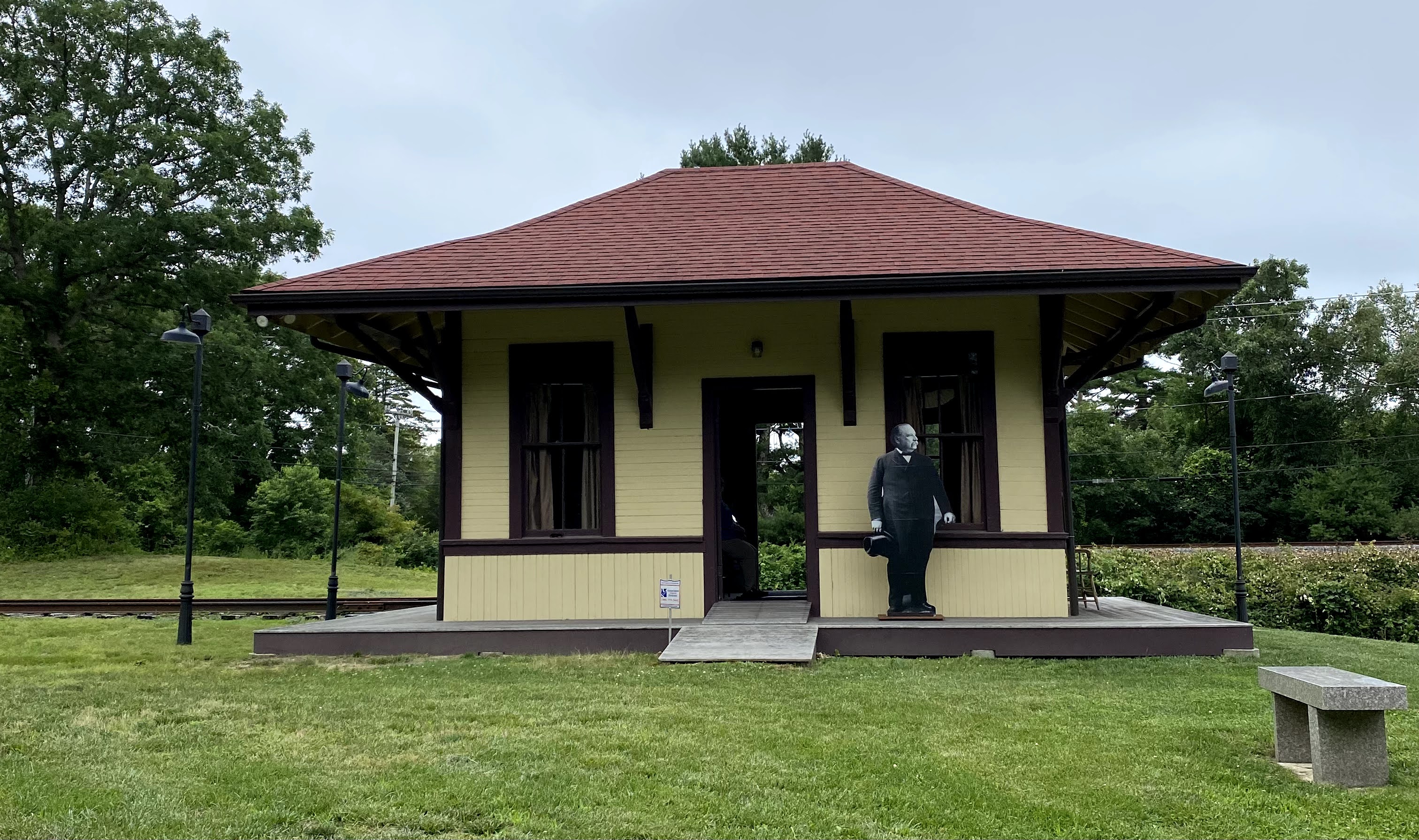


The Pilgrims built the trading post in 1627 on the banks of Manomet River to trade with local Wampanoag people and Dutch traders. The river was gobbled up by the construction of the Cape Cod Canal. There were excavations in 1852 and 1926, and an archaeological dig was done by students in 1995. The items discovered in 1995 include animal bones, turtle shells, and pieces of clay pipes, bits of pottery, and shards of glass from windows, all believed date from 1650 to 1770, so likely include items belonging to Ezra Perry’s family.  Some items found in the excavations were used in building the replica including beams and endearingly imperfect bricks.


I always get a shiver down my spine when I walk the same path my ancestors would have walked, but when the terrain is so close to what they would have traveled it really gets to me! After visiting this gem of a place, you can walk a few steps to the paved path that travels along the Cape Cod Canal. There’s also a wooded path to a clearing where you can sit on benches and watch the ships travel along the canal.


I’m now eager to learn more about the Aptuxcet Trading Post, so if anyone has some good resources I’d appreciate hearing from you!


Tuesday, August 11, 2020

Book Review: A Stranger Among Saints by Jonathan Mack


Book Review

I'm going off in a different direction, offering my opinion on a book, something I'll be doing as a change of pace from time to time. A Stranger Among Saints: Stephen Hopkins, the Man Who Survived Jamestown and Saved Plymouth, by Jonathan Mack, Chicago Review Press, 2020.

Mayflower passenger Stephen Hopkins is one of my favorite ancestors. There has been a fair amount written on him that shows him to have been adventurous, intelligent, strong in his opinions, and open-minded for the times. He even inspired Shakespeare’s Tempest! I dragged my heels about purchasing Jonathan Mack’s book because I was doubtful he could possibly offer anything new about Stephen Hopkins. A cousin suggested I read it, so I stopped procrastinating and ordered it through Amazon. I’m very glad I did! I’ve long felt Hopkins does not get credit for his important role in the founding of Plymouth (he was the only passenger who knew about the Algonquian culture and language from his time at Jamestown), and Mack does much to solidify Hopkins’ position in history. If you are not familiar with Stephen Hopkins, you can read a sketch I wrote about him here.

Jonathan Mack gives a good deal of credit to Hopkins for saving the struggling colony, decimated by loss of life during the first winter. If not for help from Native Americans, it’s possible no one would have survived. Hopkins was the only colonist who welcomed Abenaki sagamore Samoset to stay in his home, a move that may well have saved the colony. He served as a bridge between the Natives and the Colonists throughout his life.

Because he participated in an insurrection after being shipwrecked on Bermuda, the author argues Hopkins would have had significant input into the Mayflower Compact, the first written constitution in the New World,  

The author shows Hopkins that doesn’t get the credit he deserves because he didn’t play by the rules, often finding himself on the wrong side of popular (pious) opinion and sometimes the law itself. Even though he was a “stranger” and not a Separatist “Saint,” he won their favor early, serving in a variety of capacities including Assistant Governor. He eventually fell out of favor because of his penchant for not following rules and getting in trouble with the law.

Mack’s writing style is very readable and the 272 pages are a quick read. For anyone with Mayflower connections or an interest in the early history of our country, reading this book is time well spent.


Sunday, March 17, 2019

Love Brewster (b. ca 1610 Holland, d. January 1650/51 Duxbury, Mass.) and his wife Sarah Collier


Love Brewster was born circa 1610, in Leiden, Holland, the son of William and Mary Brewster. It is believed he was about nine when he came to Plymouth on board the Mayflower. He is my 9th great-grandfather on my grandfather Art Washburn Davis’ side of the family. I wrote about William and Mary Brewster here.
Love married at Plymouth on 15 May 1634, Sarah Collier (PCR 1:30). Sarah was the daughter of William and Jane Collier. She was baptized St. Olave, Southwark, Surrey, on 30 April 1616. 

Jane and Love lived in Duxbury and raised four children there: Sarah, Nathaniel, William, and Wrestling. After Love’s sister Fear Allerton died, they also bought up her son Isaac. 

I descend from their son William Brewster who married Lydia Partridge of Duxbury.

Love was included in the 1627 Cattle Division as part of the household of his parents William and Mary Brewster. In 1636 he was a Pequot War volunteer, but Plymouth’s soldiers weren’t needed. Love became a freeman in Plymouth Colony on 2 March 1635/6. He was, along with his father and others, an original settler of Duxbury, sometimes spelled Duxburrow and Duxborough. He volunteered for the Duxbury militia under Captain Myles Standish.

Early on Love and Sarah Brewster lived in an area called the Nook, a cove area, now known as Standish Shore. Love lived next to his father William Brewster, eventually moving in with his father as the latter aged. Love inherited the farm after his father died in 1644. Jonathan and Love were the only sons to survive William Brewster, and they divided their father’s 111 acres in Duxbury.  Love received 43 acres on the east side of Eagle Nest Creek; Jonathan received more acres but it is thought that Love’s land was of better quality.

The location of William Brewster’s house, later Love’s home, is off what today is Marshall Street. Although there is some question, it looks like in 1646 Love sold part of the farm to Samuel Eaton, son of Mayflower passenger Francis Eaton. In Duxbury: Ancient and Modern, Henry Fish writes that Love Brewster moved next to his father-in-law William Collier’s house on Waiting Hill near North Hill and he shows the location on a map included with the book. Collier was the richest man in the colony.

In 1642, Love’s household must have been rocked by the conviction of his servant Thomas Granger for buggery with a variety of animals, including a mare, cow, two goats, diverse sheep, two calves and a turkey. Thomas, who is my 11th great-uncle, was sentenced to death by hanging after all of the animals were killed in front of him (according to Leviticus 20:15 the animals were unclean and not fit for work, food or clothing). Gov. Bradford described Granger as about 16 or 17 years old. Although sodomy and buggery were considered by the Pilgrims worse offences than premarital sex and adultery, there must have been public outcry as Thomas was the last man executed for a sex crime in the Colony. Aside from the horror of what happened to Thomas, losing such scarce and valuable livestock would have been a tremendous loss for Love Brewster. I’m assuming the animals belonged to Love, but I’m not sure about that. 

In Bradford's 1651 accounting he says Love "lived till this year 1650 and died and left four children, now living."

Love Brewster died, presumably in Duxbury, between 6 Oct 1650 (when will was written) and "last day" January 1650/1 (inventory taken). He was about 40 years old.

Love Brewster's probate is recorded in the Plymouth Colony Wills and Inventories, Volume 1, folios 89, 90 and 91. The will was written 6 October 1650 and proved 4 March 1650/51. It mentions his wife Sarah and children Nathaniel, William, Wrestling and Sarah. All to receive a kettle, sons to each receive a gun. Wife Sarah was to receive the residue of his whole estate, goods, chattel, and land at Duxburrow for the bringing up of their children. His land was to go to eldest son Nathaniel after Sarah’s decease; if he should die then to William, then to Wrestling.  His wife Sarah was to distribute his books. Land that was due to Love by purchase or for being a first-comer in 1620, should be equally divided by his three sons. Wife Sarah was to be executrix. Witnessed by Myles Standish.

An inventory of his estate was taken by William Collier (his father-in-law) and Captain Myles Standish on the last day of January 1650[/51] and totaled over 97 pounds, not including real estate. It includes a detailed account of household items such as a salt cellar, firkin, and candlestick; furnishings such as two cradles, two old stools, three chests, four featherbeds; clothing; faming tools such as three wedges and rakes; a large collection of books (presumably many inherited from his father) including two books of the commandments, a Bible, five books of Moses, Cotton’s Concordance, a dictionary, a book of Husbandry, a French dictionary, and a book on the Spanish Inquisition; and firearms including pistol, powder, shot, powder horns, pair of bandoliers, shot bag; livestock including three cows, a yearling, a sow, two “shoats,” three ewe sheep, poultry; bushels of wheat, rye Indian corn, peas, barley, oats, malt.

Sarah survived Love for thirty years, dying on 26 April 1691 at Plymouth in her 76th year. She had married, second, Richard Park/Parke of Cambridge sometime after 1 September 1656. Richard Park died in 1665. 

There are no surviving headstones for Love and Sarah Brewster. It is quite possible they are buried at the Myles Standish Cemetery in Duxbury.

Sources:
Robert Charles Anderson, The Great Migration Begins, 2000
Mayflower Families in Progress, William Brewster
Barbara Lambert Merrick, Mayflower Families in Progress, William Brewster of the Mayflower and his Descendants for Four Generations, 1997
Torrey’s New England Marriages
James Deetz and Patricia Scott Deetz, The Times of Their Lives: Life, Love and Death in Plymouth Colony, 2000
Mary B. Sherwood, Pilgrim A Biography of William Brewster, 1982
Lamont “Monty” Healy, Elder William Brewster and the Nook, 3-part series, Duxbury Clipper, June 26, July 24 and August 28, 2013 (Note: Mr. Healy’s excellent series of Duxbury Clipper articles are available for purchase on the Duxbury Rural & Historical Society website)

Wednesday, July 20, 2011

Mayflower Ancestors Pt. 11: Francis Eaton

Francis Eaton is an ancestor who tugs at my heart strings as he had a life filled with tragedy. The misfortune started early--all of Francis’s siblings, except for his brother Samuel, died in 1603/1604, apparently due to a sickness that had spread through the household. 

Francis was baptized 11 September 1596 at Bristol, Gloucestershire, England, the son of John Eaton and Dorothy Smith. He became a house carpenter in England, which may have been why the Separatists wanted him to come to America with them. He was not a Separatist but rather a “stranger.” Francis had at least some education as he signed his name to documents.
Francis Eaton Signature from mayflowerhistory.com

Francis married first Sarah, whose maiden name is unknown, about 1618-19, in England. They had a son Samuel who was an infant on board the family’s voyage aboard the Mayflower. Sadly, Sarah died during that first difficult winter at Plymouth. 
 
Francis married second Dorothy, maiden name unknown, before 1623 at Plymouth. She was a maid servant to John Carver who had died in the spring of 1621, as did his wife, leaving Dorothy on her own. 

In the 1623 Land Division, Francis received four shares: one for himself, one for his deceased wife Sarah, one for his son Samuel, and one for his current wife Dorothy. Dorothy must have died soon after the division of land at Plymouth. 

Francis was about 26 years of age and had already lost two wives, but he forged ahead and married yet again. He married third Christian Penn around 1625 in Plymouth. Christian had arrived in 1623 on the “Anne.” They had three children together: Rachel, Benjamin and a third child whose name is unknown. The unknown child was called an “ideote” and was still living in 1651. I can’t imagine how people coped with a child with a severe disability given how difficult life already was for them. 

Francis died in the fall of 1633, apparently dying of an infectious fever that swept hrough Plymouth.  He was just 37 years of age and left behind a wife and four young children. 

His estate included one cow and a calf, two hogs, fifty bushels of corn, a black suit, a white hat, a black hat, boots, four pewter platters, fishing lead, and many carpentry tools including , hammers, an adze, square, augers, a chisel, boards, saws. See a list of his inventory at: http://www.pilgrimhall.org/willfeaton.htm. 

In July 1634, Christian married second Francis Billington, whose father John was hanged for murder in 1630. She and Francis Billington had nine children together. She died circa 1684, probably at Middleborough.

My line of descent from Francis and Sarah Eaton:

1      Francis Eaton 1596 - 1633
+Sarah Unknown   
2      Samuel Eaton  1620 - 1684
+Martha Billington 1638 - 1704
3      Mercy Eaton   1665 - 1703/04
+Samuel Fuller        1658 - 1728
4      Benjamin Fuller      1695/96 -
+Mary Samson       
5      Samuel Fuller  1724 - 1758
+Ann Tinkham        1726 - 1758
6      Mary Fuller    1748 - 1802
+Jabez Nye     1749 -
7      Desire Nye       1771 - 1858
+David Pierce 1773 - 1820
8      Lucy Nye Pierce      1809 - 1896
+Rowland Sturtevant Bumpus        1804 - 1853
9      Mary Briggs Bumpus      1840 - 1916
+Seth Washburn     1828 - 1921
10    Charles Francis Washburn     1857 - 1941
+Hattie Maria Benson    1861 - 1914
11    Carrie Clyfton Washburn      1896 – 1974
+George Brewster Smith        1895 – 1913
12    Arthur Elmer Washburn Davis      1913 - 1976
+Mildred Louise Booth   1917 – 1999
13    My parents
14   Me 

Richard Gere is a descendant of Francis Eaton.

Monday, July 18, 2011

Mayflower Ancestors Pt. 10: Isaac Allerton

I never know quite what to think of Isaac Allerton. He certainly was a successful businessman, but how many people did he hurt or take advantage of on his way to making so much money?

Isaac was the son of Bartholomew and Mary (____) Allerton, likely born East Bergholt, Suffolk, about 1587. He was of the Pilgrim contingent that lived in Leiden, Holland and was about 34 years of age when he came to Plymouth on the Mayflower.
Forefathers' Monument at Plymouth


Isaac married first Mary Norris at Leiden, who died at Plymouth on 25 February 1620/21, during that first winter when so many colonists died. They had children Bartholomew, Remember and Mary born in Leiden. All of them were on the Mayflower with Isaac and Mary. They also had an unnamed baby they buried in February 1620 in Leiden and another stillborn on the Mayflower when anchored at Plymouth (source: Mayflower Families Through Five Generations: Vol 17). 

He married second Fear Brewster, daughter of William Brewster, between 1623 and 1627. They had children Sarah and Isaac. Fear died before 12 December 1634. 

He married third Joanna Swinnerton, possibly at New Haven, CT, between 1634 and 1644. 
Allerton Cushman Cup, Pilgrim Hall Museum

Inscription on the Allerton Cushman Cup, which has the year 1608 carved on the bottom:
  Lord help thy people that are in Destresse:
teach all true Christians for to help each other:
turne + the hard hart's that Doth the poore opresse:
teach them to know their needy Christian Brother:
Think on+the ritch mans flourishing estate:
Which cried out in hell+Blessed are the mercyfull+Wh-t was to late.

Isaac was a tailor at Leiden, listed as being from London. He was called a merchant in Plymouth and became a very wealthy businessman. He served as Assistant Governor of the Colony, second in command only to William Bradford, for about 11 years. He acted as the agent for the group, traveling multiple times to England to negotiate a buyout from the Merchant Adventurers that had financially backed the Pilgrims. He eventually began using these trips to further his own personal gains, purchasing goods to sell in the colonies.  

Isaac also engaged the Colony in money making schemes without permission. When his business ventures failed, the Colony fell even further in debt. He negotiated the purchase of land at Machias, Maine, as a trading post for the colonists. He founded the Marblehead cod fishing industry and transported Separatists from Leiden to Plymouth.

Some of the trading he did included buying beaver pelts from Swedes and Finns along the Delaware, in turn supplying them with food and supplies in times of scarcity and shipping tobacco to Sweden. He was a diplomat as well, hosting a summit conference between officials of New Sweden and New Haven colonies to avert a war. 

The death of his wife Fear, combined with the anger some of his fellow colonists held against him, may have prompted him to relocate to New Haven, Connecticut. He remained an active trader and did regular business with the Dutch at New Amsterdam (modern-day New York), the Finns and Swedes at New Sweden (consisting of parts of present day Delaware, New Jersey and Pennsylvania), Virginia, and Barbados. 

He purchased a house in New York City on Broadway, an East River warehouse, a Manhattan wharf, land in Virginia, and one of the finest homes in New Haven.

Isaac also had a sister Sarah on board the Mayflower who married Degory Priest. There was also a John Allerton on board, but his relationship to Isaac has not been learned. 

He died in January 1558/59 at New Haven Connecticut.  No death record is found for him, but his inventory was taken 12 Feb 1658. He had appeared at court in New Haven on 1 Feb 1658/9. His signature on a bond survives.
Isaac Allerton's signature from www.mayflowerhistory.com

The Massachusetts Historical Society owns Isaac Allerton’s bible, but it is not known whether it first belonged to Isaac Sr. or Jr. 

My line from Isaac Allerton, not yet submitted to the Mayflower Society:

1      Isaac Allerton 1586 - 1658/59
+Fear Brewster       1606 - 1634
2      Mary Allerton
+Thomas Cushman 1607/08 - 1691
3      Thomas Cushman  
+Ruth Howland      1646 -
4      Robert Cushman    
5      Ruth Cushman        1700 -
+Luke Perkins 1695 -
6      Ignatious Perkins    1720 -
+Keziah Davis 1724/25 -
7      Ruth Perkins   1752 - 1799
+Jesse Pierce   1747 - 1834
8      David Pierce   1773 - 1820
+Desire Nye     1771 - 1858
        9      Lucy Nye Pierce      1809 - 1896
+Rowland Sturtevant Bumpus        1804 - 1853
10    Mary Briggs Bumpus      1840 - 1916
+Seth Washburn     1828 - 1921
11    Charles Francis Washburn     1857 - 1941
+Hattie Maria Benson    1861 - 1914
12    Carrie Clyfton Washburn      1896 - 1974
+George Brewster Smith        1895 - 1913
13    Arthur Elmer Washburn Davis      1913 - 1976
+Mildred Louise Booth   1917 - 1999
14    My parents
15    Me

Franklin Delano Roosevelt and Zachary Taylor were Allerton descendants. 

For information on the Isaac Allerton Colony in Florida: http://flmayflower.com/colonyfiles/Isaac%20Allerton%20Colony.pdf

Update 22 October 2023:

Caleb Johnson, Sue Allan, Simon Neal, NEHGS Register, “The Origin and Parentage of Mayflower Passenger Isaac Allerton in East Bergholt, Suffolk,” Vol 173 (Summer 2019):197-205, shares the discovery of the identification of Isaac’s parents: Bartholomew and Mary (____) Allerton, sometimes spelled Alderton, of East Bergholt, Suffolk, where Isaac was likely born about 1587. Unfortunately parish registers for East Bergholt do not exist prior to 1653. Bartholomew and Mary were recusants who followed their Brownist beliefs, so they likely would not have been married or had children baptized in the Church of England. 


There is also a Ralph Allerton of Great Bentley, Essex, possibly Isaac’s grandfather or great-uncle, who was burned at the stake as a heretic on 17 Sept 1555. No direct evidence is found for this relationship, but the surname is rare in Essex and Suffolk and that combined with he history of religious non-conformity, means they are likely closely related. 


Sunday, July 17, 2011

Mayflower Ancestors Pt. 9: Samuel Fuller

I’m so fortunate to share common ancestors with Paul Bumpus, the Historian General of the General Society of Mayflower Descendants. I’ve been corresponding with him since well before he worked for the Mayflower Society and he was so helpful to me in my Bumpus and allied families research. Paul found evidence that Mary/Molly Fuller was the daughter of Samuel 5 Fuller and Ann Tinkham, opening up multiple Mayflower lines. I’ve heard people say how snooty people involved in the Mayflower Society are, but my personal experience has never found that to be true, and in fact just the opposite. 

Samuel Fuller has generally been identified as the son of Robert Fuller, a butcher, and baptized on 20 January 1580 at St. Mary Church, Redenhall, Norfolk.  There isn’t strong evidence that he is this Samuel, other than naming patterns and that his father was a butcher, as was the Robert Fuller of Redenhall.  
St. Mary Church Redenhall source: www.norfolkchurches.co.uk
 He married first Alice Glasscock, second Agnes Carpenter, and third Bridget Lee. Nothing is known of Alice. He had two children at Leiden, Holland, by Agnes but neither survived. Agnes died in Leiden as well. Samuel married Bridget Lee in Leiden on 27 May 1617, but came on the Mayflower without her. She arrived in 1623 on the Anne. They had children Mercy and Samuel born in Plymouth.  Samuel was a signer of the Mayflower Compact.

Samuel was the Colony's doctor, a surgeon and a church deacon.  His wife Bridget may have been a deaconess and is said to have been a midwife and involved in teaching.  She gave the church a garden plot in 1664. 
Fuller Family Salt, Pilgrim Hall Museum

He owned at least 30 books and signed documents with his signature.   

Samuel's signature from mayflowerhistory.com
Where he learned to be a physician isn’t known, but he was trained in Leiden to be a serge (wool) weaver so one would imagine it took place in Leiden and not England. He may have observed public dissections at the University of Leiden and studied medicinal herbs in the school’s botanical garden. He served as an assistant to the Governor in Plymouth. 
Fuller cradle from Pilgrim Hall Museum

His will states he lived at Smelt River. At the time of his will, his wife was also very ill and he made arrangements for the care of his daughter Mercy, and the other children in his care named Sarah Converse and William Ring. Bridget did recover, however. He mentions providing for Mercy and Samuel’s education. He also states that George Foster, who seems to have been indentured to Samuel, be returned to his mother. He mentions two servants and a "cousin" Samuel, but perhaps this is actually his nephew. He had a large estate, as he made bequests to many family and friends, including William Brewster, as well as to the church. 

Site of Samuel Fuller's house, Leyden Street, Plymouth
Samuel’s brother Edward Fuller came over on the Mayflower as well, but died during the first winter. Samuel took in Edward’s son Samuel, then about 12 years of age, so all the Samuels do get confusing!

He spent time helping the sick at Neumkeag (now Salem) in 1629 as there was an outbreak of illness amongst the new arrivals. He himself became sick in the autumn of 1633 and died, as did a number of other Plymouth residents. He was about 53 years of age. There was a smallpox epidemic at the time, but it is not known if that is definitely how he died. 

Bridget’s death date is not known but she died after 2 May 1677.

My line from Samuel Fuller, not yet submitted to the Mayflower Society:

1      Samuel Fuller  1579/80 - 1633
+Bridget Lee   - 1677
2      Samuel Fuller  1629 - 1695
+Name Unknown   
3      Samuel Fuller  1658 - 1728    
+Mercy Eaton 1665 - 1703/04
4      Benjamin Fuller      1695/96 -
+Mary Samson       
5      Samuel Fuller  1724 - 1758
+Ann Tinkham        1726 - 1758
6      Mary Fuller    1748 - 1802
+Jabez Nye     1749 - 1802
7      Desire Nye       1771 - 1858
+David Pierce 1773 – 1820
8      Lucy Nye Pierce      1809 - 1896
+Rowland Sturtevant Bumpus        1804 - 1853
9      Mary Briggs Bumpus      1840 – 1916
+Seth Washburn     1828 - 1921
10    Charles Francis Washburn     1857 - 1941
+Hattie Maria Benson    1861 - 1914
11    Carrie Clyfton Washburn      1896 - 1974
+George Brewster Smith        1895 - 1913
12    Arthur Elmer Washburn Davis      1913 - 1976
+Mildred Louise Booth   1917 – 1999
13    my parents
14    me

Richard Gere is a descendant of Samuel Fuller (source Notable Kin, by Gary Boyd Roberts). 

For information on the Fuller Society, see http://www.fullersociety.com/.