If I had to pick a favorite Mayflower ancestor, Stephen Hopkins would be the winner. I relish learning about his interesting life. He was an independent, outspoken man who couldn’t be pigeon holed into pious or trouble maker; he was a bit of each. He comes across as an intelligent man (he knew the scriptures, signed his will and his inventory included a collection of books) who had an adventurous and entrepreneurial spirit, which again contrasts with his work as a minister’s assistant. Not a predictable man.
There are varying accounts of Stephen’s origins, but The American Genealogist 79:241-249 (Oct 2004) article by Ernest Christensen shows he was baptized the last of April 1581 at Upper Clatford, Hampshire, England, the son of John Hopkins and Elizabeth Williams.
In 1609, he was on board the Sea Venture, headed to Virginia. He was delegated to read the psalms and scriptures at Sunday services on board. Writer William Strachey was on board and wrote Hopkins was "a fellow who had much knowledge of the Scriptures and could reason well therein." The vessel was shipwrecked at uninhabited Bermuda. Stephen questioned the authority of the group leaders, since their charter was for Virginia and they were in Bermuda and led a mutiny against them. The insurrection was unsuccessful, and he was sentenced to be executed but pleaded his case convincingly and was spared. Perhaps Stephen begged for his life for the sake of his wife and young children. The other rebels, all single men, were executed. The group built a vessel and eventually made it to Virginia, although apparently Stephen did not stay very long, returning to England in two years. When William Shakespeare heard of Strachey's account of the shipwreck he wrote The Tempest, with Stephano as a main character.
 |
| The Wreck of the Sea Venture by Christopher M. Grimes |
|
Stephen’s first wife Mary (maiden name unknown) and his daughter Elizabeth had died before he again struck out for Virginia, this time on board the Mayflower. He was married to Elizabeth (Fisher) and they had a two year old daughter, Damaris. His teenage children Constance and Giles were also on board, and Elizabeth gave birth to a son, Oceanus, on the voyage. The family also brought along two servants. Oceanus would die in his infancy and Damaris died as a young child. Stephen and Elizabeth had additional children, Caleb, Deborah, another Damaris, Ruth and Elizabeth, all born at Plymouth.
 |
| Gov. Bradford's comments on the Hopkins family |
|
Stephen appears to have been a bit of a rebel on board the Mayflower, a dissenter questioning the authority of the leaders (sound familiar?) in New England since they went astray of landing in Virginia. He was likely behind the writing of the Mayflower Compact, a document outlining how their new society would run.
 |
| Copy of the Mayflower Compact |
Hopkins had his share of conflicts with the powers that be: he was fined for battery of John Tisdale; fined in 1638 for dealing unfairly with apprentice-girl Dorothy Temple; fined for selling glass at too high a price; fined for selling illegal intoxicants; fined for serving drink on a Sunday at his house. He and friend Myles Standish were ambassadors to the Indians, and he participated in many of the early exploring missions, serving as an interpreter to the Indians (one of the reasons the Separatists likely wanted him on the journey). He was important in the relations between the Pilgrims and the Indians, entertaining Samoset in his home and serving as envoy to Chief Massasoit. He volunteered to fight in the Pequot War of 1637.
Stephen’s family was one of the few that escaped loss of life in the first winter. He was referred to as a tanner or leathermaker at the time of the voyage and a merchant and planter in Plymouth Colony records. He also apparently was a tavern keeper. He kept his home at what is now the corner of Main Street and Leyden Street for his entire life, except a brief time in Yarmouth where he did not stay, giving that land to his son Giles. He built the first wharf on record in Plymouth Harbor.
I find it fascinating that even though Hopkins was not part of the Separatist group and defied some of their laws, he must have quickly gained their respect as he served as Assistant to the Governor for 13 years. Perhaps his early transgressions were primarily because of the distrust the Separatists held for the “strangers.”
In the summer of 1644, Stephen died in Plymouth at age 63. His wife Elizabeth had already passed. His children Constance, Giles, Deborah, Damaris, Elizabeth and possibly Ruth and Caleb (the latter would die in Barbados) survived him.
 |
| Constance Hopkins' Beaver Hat, Pilgrim Hall Museum |
|
My lines from Stephen Hopkins. The first one would be difficult to prove because Thomas Snow is not given as a son of Joseph Snow in the Stephen Hopkins Mayflower Silver Book.
1 Stephen Hopkins 1581 - 1644
+Mary - 1613
2 Constance Hopkins 1606 - 1677
+Nicholas Snow 1599/00 - 1676
3 Joseph Snow 1634 - 1722/23
+Mary - 1722/23
4 Thomas Snow
+Priscilla Butler 1691 -
5 Thomas Snow 1740 - 1813
+ Elizabeth Nickerson 1730 - 1803
6 Priscilla Snow 1767 - 1849
+Richard Chase 1767 - 1850
7 Priscilla Chase 1796 - 1882
+Oliver Kelley 1795 - 1883
8 Valentine Kelley 1828 - 1882
+ Rosana S. Eldredge 1826 - 1911
9 Mary Ann Kelley 1855 - 1941
+David Howes Kelley 1842 – 1925
10 Ethel Florence Kelley 1890 - 1981
+Wallace Cedric Booth 1887 – 1970
11 Mildred Louise Booth 1917 - 1999
+Arthur Elmer Washburn Davis 1913 – 1976
12 My parents
13 Me
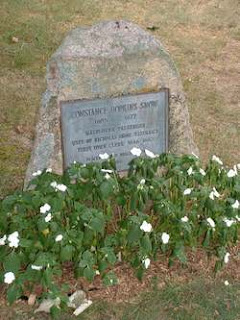 |
| Constance Hopkins Memorial Stone, Cove Burying Ground, Eastham, MA |
3 John Snow 1638 - 1692
+Mary Smalley 1647 - 1703
4 Rebecca Snow 1676 - 1753
+Benjamin Small 1665 - 1721
5 Mary Small 1704/05 - 1755
+John Nickerson 1703 - 1768
6 Elizabeth Nickerson 1730 - 1803
+[Thomas Snow 1740 – 1813
Then Priscilla Snow and Richard Chase down to me
2 Giles Hopkins 1608/09 - 1688/89
+Katharine Whelden 1616/17 - 1688/89
3 Deborah Hopkins 1648 - 1686/87
+Josiah Cooke 1645 - 1731/32
4 Deborah Cooke 1678/79 - 1745
+Moses Godfrey 1667/68 - 1743
5 Desire Godfrey 1712 - 1741/42
+Nathaniel Ryder 1705 - 1749
6 Esther Ryder 1731 - 1802
+Thomas Freeman 1731 - 1800
7 Dorothy Freeman 1752 - 1825
+Elnathan Eldredge 1746/47 - 1837
8 Nehemiah Eldredge 1775 - 1839
+Ruth Harding
9 James Harding Eldredge 1797 - 1873
+Rosanna Wixon 1789 - 1868
10 Rosana S. Eldredge 1826 - 1911
+Valentine Kelley 1828 - 1882
Sarah Palin is a descendant of Stephen Hopkins (Source: Notable Kin, Gary Boyd Roberts).
An excellent book on Stephen Hopkins: Here Shall I Die Ashore, by Caleb Johnson.


