James Chilton was a Mayflower passenger who sadly did not survive to see Plymouth—he died on board the ship as it was anchored in Provincetown Harbor. He is my 12th great-grandfather on my grandfather Arthur Washburn Ellis Davis’ side of the family. I have learned more about James since I wrote an earlier post, primarily from Sue Allan’s book In Search Of Mayflower Pilgrim James Chilton of Canterbury and a series of articles by Michael Paulick.
James Chilton was born about 1556 likely in St. Paul Without Walls, Canterbury, Kent, England, where he was raised. His parents were Lionel and Edith Chilton; Edith’s maiden name is not known. [Anderson] He had siblings John, Alice, Ann, and Margaret. The church register of baptisms does not cover the period of James’ birth, but he is shown to be Lionel’s son in a variety of records including Lionel’s will. James’ grandfather Richard Chilton was also from St. Paul’s so the family had been in the parish for at least three generations.
 |
| St. Paul's Church outside the Canterbury walls |
Lionel appears to have been a prosperous man but not of the gentry class. He was a bricklayer, a respectable profession at the time, and owned multiple properties and many acres of land. He owned The Swan and The Wool Sack, presumably ale houses. He grew grain, owned a mill house to process it, and brewed ale. He was a churchwarden which was an elected, unpaid position filled by trustworthy men of good pubic standing. His inventory shows he lived in a large home that included a good deal of furniture, decorative painted cloths, silver, books, helmets, and guns. Buildings on his property included a brew house, well house, mill house, milk house, bake house, and corn lofts. A stable was mentioned later in arbitration between his sons. [Allan]
James became a Merchant Tailor and Freeman by Gift of Canterbury in 1583. The mayor was allowed to nominate one freeman by gift within a year of taking office and James was his choice. James purchased a place in the company of Woolen Drapers and Tailors. As a freeman, he could operate his business without restraint within the walls of Canterbury and could employ apprentices. [NEHGR 153:408-412]
James married by 1584 a woman whose name is not recorded.
Children of James and his wife had ten children [baptisms from Sherman]:
- Joel baptized St. Paul’s Canterbury 16 August 1584 (no father’s name given); buried 2 Nov 1593 as son of James Chilton
- Isabella bp St. Paul’s 15 January 1586/7; m. Leiden 21 July 1615 Roger Chandler [MD 11:129]
- Jane bp St. Paul’s 8 June 1589; no further record
- Mary buried St. Martin’s 23 Nov 1593
- Elizabeth bp St Martin’s, 14 July 1594; no further record
- James bp St. Martin’s, 22 August 1596; died by September 1603
- Ingle bp St. Paul’s, Canterbury, 29 April 1599; believed to be Engeltgen Gilten who m. Robert Nelson at Leiden 27 August 1622; no further record
- Christian, daughter bp St. Peter’s, Sandwich, Kent, 26 July 1601; no further record
- James bp St. Peter’s Sandwich, 11 Sept 1603 [MF 2:5]; no further record
- Mary bp St. Peter’s Sandwich, 30 May 1607 [MF 2:5]; m. Plymouth John Winslow by 22 May 1627
I descend from their youngest child, Mary. I wrote about her here.
James lived in tumultuous times: [Allan]
- Under the reign of Catholic Queen Mary over 300 Protestants deemed heretics were executed by burning.
- When Queen Elizabeth came to power, the country returned to the Protestant faith, and in 1588 three Catholic priests were executed in a nearby town.
- James lived through a major earthquake in April 1580. A resulting tsunami caused 165 ships to capsize and a number of people drowned. It occurred during Easter week and many viewed it as a sign from God.
- The war between England and Spain was also backdrop to James’ life.
- There were droughts, floods, and a plague that caused food shortages. The lack of grain to make ale and disposable income for new clothing would have greatly impacted James’ livelihood.
James appeared in court multiple times, often acting as bondsman for marriages. In 1584 he was ordered to appear in court and "to keep the peace;” no details given. Later that year he and another man posted bail of ten pounds each for Alexander Stonnard. In April 1586 he was presented for "chiding and brawling” [did not refer to physically fighting at the time] in the chancel floor of Church. In 1593 he and two other men, including his brother-in-law, were "bound over" for the large sum of more than £66; crime was not specified. In 1594 he was in trouble for beating a man with a stick. In 1598 he and another person guaranteed to the court the good behavior of Richard Allen, who kept an alehouse. In 1600 he was fined six shillings and eight pence for "victualling" (selling food and/or drink) without a license. The fine was canceled when he agreed to cease after Christmas. [New England Ancestors, Spring 2007] It could be James was a hothead or perhaps he was a man who stood up for his beliefs. In the case of the “brawling” at church, he came to the defense of a blacksmith who was arguing with a wealthy alderman. [Allan]
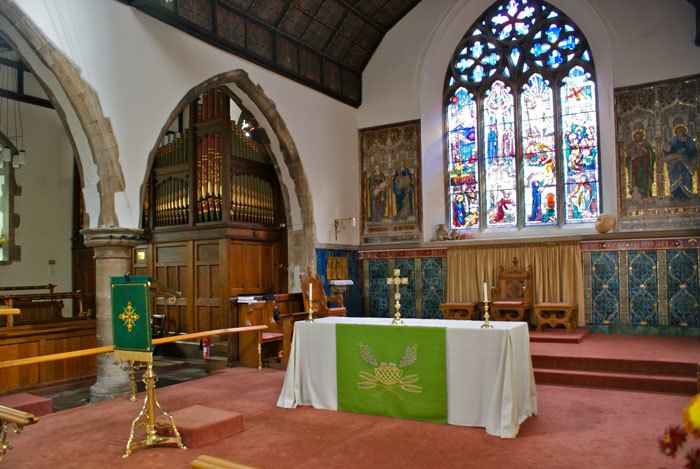 |
| Interior of St. Paul's |
By July 1601 James moved his family to the port town of Sandwich, about 12 miles from Canterbury. It was a big deal to relocate, especially with James’ deep roots at Canterbury, his business connections, and his freeman status. Exactly why James moved is not known—perhaps he was in debt due to all of the conditions previously mentioned or his religious beliefs meant he could no longer honor his freeman’s oath. The parish of St. Peter’s in Sandwich was home to many non-conformists, so that could have been a factor. Some of these non-conformists would later go to Leiden including Roger Wilson, Thomas and Mary Shingleton, Richard and John Masterson, and Moyses Fletcher. [Allan]
St. Peter's, Sandwich

Lionel Chilton died in January 1582 and wording in his will indicates that he anticipated discord amongst his heirs. James was bequeathed his father’s property called The Wool Sack, which included a house, land, and presumably a tavern. His father also directed for James to take care of his step-mother Isabel (Wilson) (Furner) Chilton who married, 3rd, Nicholas Graunt, but perhaps after his death returned to live with James at Sandwich as she died there in 1607. This leads to conjecture that Isabel was James’ mother-in-law. [Allan]
Sue Allan believes the location of James’ property, The Wool Sack in St. Paul’s, was Barton Court, a farm property which was originally the mansion house or court of the Abbot of St. Augustine’s. Her book includes a photograph of a surviving building on the property.
In October 1584 James and his brother John sought arbitration in a dispute about building a drain in the ground between their properties and a few other issues, so it appears their father was correct in thinking there would be disharmony with his estate. [Allan]
James seems to have had some education, perhaps at Kings Grammar School. To dress the gentry as a tailor, James would have been well dressed, neat and clean in appearance. [Allan]
James and his wife were religious dissenters, eventually becoming Separatists. Canterbury and East Kent had a strong Puritan presence and a number of Protestant refugees from Europe, including displaced Walloons. In May 1593 two Separatist leaders were executed at London; it must have been shocking to hear of Protestant vs. Protestant violence. In April 1598 “the wife of James Chilton” was part of a group that secretly buried a child to avoid the Church of England burial services, and excommunication proceedings against her began. [NEHGR 153:408]
Likely because England was becoming increasingly unsafe for dissenters, in about 1609 James and his wife and children left their homeland to live at Leiden, Holland. They joined John Robinson’s group of Separatists, then called the Christian Reformed Religion, many of whom became the Pilgrims who founded Plymouth, Massachusetts. The city was thriving mostly due to the cloth trade, which would have been a fit for James. Pay however was meager, which made it a challenge to survive. The Chiltons lived on Vollersgracht [voller meaning fuller/wool workers and gracht meaning canal) which is now called Langebrug. Their house was in a little gated courtyard at corner of Diefsteeg and Langebrug. [Allan] That James acted as a bondsman for marriages suggests he may have been more financially secure than many other Pilgrims and that he gave up much for his religious beliefs. [NEHGR Vol 174]
The year 1619 was a time of great unrest in the city with clashes between the established Dutch Church and Remonstrants, followers of Arminianism which placed emphasis on man’s responsibility and his own free will. There were armed military and cannons stationed across the city. Soon after James returned from church on 28 April 1619, he was accused by 20 youths of allowing Remonstrants to gather at his home, an untruth. The young men threw rocks and bricks at him and his injuries were life threatening. He and his daughter Ingle gave statements to the police in presence of surgeon Jacob Hey. James stated he was about 63 years of age. [Bangs] It is noteworthy that Ingle was literate, not typical for English-born females.
James was about 64, considered quite elderly as the average life expectancy in the Tudor era was 35, when he boarded the Mayflower for the dangerous crossing with his wife and their youngest child Mary. They left behind their two adult daughters in Leiden; it seems they had no surviving sons by this time. What was their motivation to take such a voyage? Was Leiden no longer tolerable to them after the attack on James? They bought no servants with them to do hard labor, so perhaps they agreed with one or more of the men traveling alone to be help mates to each other.
After a long and difficult crossing, the Mayflower was anchored in Provincetown Harbor at Cape Cod on 11 November 1620 when James was one of the men who signed the historic Mayflower Compact. He died less than a month later, on 8 December, a bitterly cold day with wind driven rain and snow and a growing sea swell. [Anderson] His likely cause of death was scurvy.
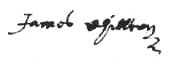 |
| James Chilton's signature |
 |
| Memorial at Provincetown honoring the passengers who died there |
Mrs. Chilton died during the first winter. Her remains would likely be buried on what is now Cole’s Hill in Plymouth. Their daughter Mary was now an orphan at just 13 years of age. She may have been raised in the household of Captain Myles Standish. She did, however, see her sister Isabella again as she came to New England with her husband Roger Chandler. What a happy reunion that must have been.
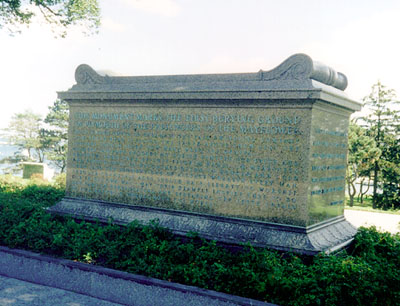 |
| Sarcophagus on Cole's Hill containing unidentified Pilgrim remains |
It’s sad to me when women’s identifies are unknown, especially when there are multiple opportunities to at least identify her Christian name in records instead of just “wife of.” Being a dissenter she was clearly a brave and strong woman. She gave birth to at least ten children and likely buried seven of them. She left a comfortable life in Kent to move to Leiden, Holland, where she would not have spoken the language initially. And then as an older woman, she crossed the ocean to Plymouth to help build a community from scratch, arriving at the onset of winter. Some people believe her name was Mary, others Susannah Furner (this is not possible as Susannah would have been 10 years old at her marriage!). Sue Allan wrote that perhaps she was Mildred Furner, James step-sister, but states this is speculation.
Sources:
Sue Allan, In Search Of Mayflower Pilgrim James Chilton of Canterbury, 2024
Jeremy Dupertuis Bangs, Strangers and Pilgrims, Travelers and Sojourners, Leiden and the Foundations of Plymouth Plantation, GSMD, 2009
Robert M. Sherman, Mayflower Families Through Five Generations, Vol 15: James Chilton and Richard More, 1997
Robert Charles Anderson, The Great Migration Begins, 1995
Michael R. Paulick, NEHGS Register, ”The 1609-1610 Excommunications of Mayflower Pilgrims Mrs. Chilton and Moses Fletcher," vol 153:408-412, October 1999
Michael R. Paulick, New England Ancestors, "The Mayflower Chiltons in Canterbury, 1556-1600, ” Spring 2007
Michael R. Paulick, NEHGS Register, “Mayflower and Other Pilgrims from Kent in Leiden in the Early 1600s,” Volume 174, Spring 2020
Michael R. Paulick, The Mayflower Quarterly, “From Dissenters to Pilgrims, 1608-1613 St. Peter’s, Sandwich, Kent,” Vol. 87, No. 3, Fall 2021


