Nathaniel Morton was born about 1613 at Leiden, Holland, the son of Separatists George Morton and Juliana Carpenter. After two failed attempts at passage, he arrived at Plymouth in 1623 on the ship Anne with his parents and siblings Patience, John, and Sarah. His father died the following year and Nathaniel went to live with his uncle, by marriage, Governor William Bradford, who groomed Nathaniel to be a colony leader. In 1645 Nathaniel became the Colony secretary (later called clerk), a position he held until his death some 40 years later. He was a devout man who through today’s lens was intolerant of anyone who held differing religious views. He is my 10th great-grandfather on my grandfather Arthur Washburn Ellis Davis’ side of the family.

I also descend from Nathaniel’s brother Ephraim who married Ann Cooper as well as his sisters Patience who married John Faunce and Sarah who married George Bonham.
Nathaniel was a scholar and historian who wrote New England's Memorial, published at Cambridge in 1669, which for many years the primary published source for history and origins of Plymouth Colony and was the first historical work to be printed in the English North American colonies. In the book, he continues the work of his uncle William Bradford's Of Plimoth Plantation which culminates in 1646.

Nathaniel also wrote First Beginnings and After Progress of the Church of Christ at Plymouth in New England. Being a religious man, he focused a great deal on Plymouth’s ministers and attributing happenings like storms and a comet as acts of God. He was an accomplished writer with strong knowledge of the Bible and local history.

Nathaniel appears in William Bradford’s household on the 1627 cattle division. Nathaniell Morton was taxed 9 shillings in the 1633 tax list; same amount in 1634. He was made freeman 3 January 1636/7. He is on the 1643 Plymouth list of Men Able to Bear Arms with his brothers John and Ephraim. He served on juries and Councils of War.
Nathaniel married Lydia Cooper 25 December 1635 at Plymouth (PCR 1:35). She was the sister of John Cooper who came to Scituate in 1634. They had eight children, as well as a stillborn daughter, all born Plymouth:
Remember born about 1638; married Abraham Jackson; died Plymouth 24 July 1707
Mercy born about 1639; m. Joseph Dunham; died Plymouth 19 February 1666/67
Lydia born about 1641; m. George Elliston
Hannah born about 1646; m. Isaac Cole and Benjamin Bosworth; died likely in Hull
Eleazer born about 1648; died Plymouth 16 January 1649/50
Elizabeth born about 1652; m. Nathaniel Bosworth; died at just age 20 on 6 April 1673
Joannah born 9 November 1654; m Joseph Prince
Nathaniel born about 1666, died Plymouth 17 Feb 1666/67
I descend from Remember, sometimes recorded as Remembrance. I wrote about Remember and Abraham here..
Nathaniel took in a boy to raise after his own two sons died young. On 12 April 1667, about 2 months after their son Nathaniel died, Nathaniel and Lydia Morton entered into an agreement with Sgt William Harlow to raise his son Nathaniel Harlow who was about two and half years old. Nathaniel Harlow's mother died a few days after his birth.
The couple’s stature in the community is obvious in Lydia’s detailed death record: Mistris Lydia Morton, the wife of Nathaniel Morton, Senr, deceased 23 Sept 1673, after she had lived with her said husband neare the space of 38 yeares. After much dollorous paine and sickness, shee ended her life with much peace and comfort. Shee was a good woman and lived much desired, and died much lamented, especially by her poor sorrowfull husband; shee was honorably buried on the 25th of the said monthe att Plymouth. (Plymouth VR 1:668)
Nathaniel married, second, Anne/Hannah Pritchard Templar, 29 April 1674 at Plymouth (PCR 8:35), the daughter of Richard and Ann Pritchard. She had married first Richard Templar.
Anne died on 26 December 1690 at age 66 “an aged woman” at Charlestown, Suffolk County, Massachusetts.
Nathaniel was a large land owner. He received land from his step-father Manassah/Manasses Kempton beginning Jan 1637/38 with 20 acres in Plymouth where Nathaniel was already living, 2 acres of fresh meadow, and marsh meadow at Island Creek in Duxbury. In February 1660 Manasses deeded Nathaniel all his portion of land known as Punckateesett in Plymouth, lying against "Road" Island. In Feb 1662 Manasses sold to Nathaniel upland at a place called Hobshole alias Wellingsly in Plymouth which was the land of Samuel Jenney. On the same day Thomas Southworth sold to Manasses Kempton of Plymouth, yeoman, land in same location. Kempton in turn deeded it to Abraham Jackson of Plymouth [Nathaniel Morton’s son-in-law]. In March 1663 the list of owners of land on Puncateeseet Neck included lot 34 of Manasses Kempton and Nathaniel Morton.
Nathaniel was also granted land by the town and colony. In September 1638 he received meadow land called Log Poynt (sold in 1652 to Experience Mitchell). January 1638/9 ten acres toward the head of his lot next to Richard Higgins. November 1640 six acres at the South Meadows toward Agawam, Colebrook Meadows. October 1642 four acres "if it be there to be had" of North Meadow by Jones River (which he swapped in 1664 for land in the lower south meadow). February 1648[/?9], an acre of meadow "lying above Mr. Atwood." March 1651/2 a "small Moyety of land lying betwixt the highway by his house and the waterside or creeke commonly called and knowne by the hobshole alias Wellingsley. The said smale moiety being compassed on the one side with the aforesaid hole or creeke and on the other side with the brooke running into the said creeke which makes it a necke..." October 1662 fifty acres of upland at the further end of Manomet Ponds near the Indians. Jan. 1665[/6] one acre meadow on the North side of the cove. June 1665, one share in 24 shares of land, about 30 acres per share, west side of Namasskett River. August 1672 the whole of the swamp of Wellingsly was granted to the "neighbors there" including Nathaniel Morton Sr and Abraham Jackson. In June 1675 Nathaniel asked the court for liberty to "seek out for some accommodation of land for himself and in the behalf of the posteritie of his brother, John Morton, deceased, as being descended of Mr. George Morton, deceased, who served the country this many years.”
In March 1645 Nathaniel Morton bought from Nicholas Snow an acre of upland at Wellingsley Brook for 10 shillings to be paid in merchantable corn at the next harvest.
In March 1647 the Plymouth church deacons sold to Nathaniel Morton for 5 pounds to be paid in corn or cattle, a house and four acres at Weelingsly Creek. On 2 April 1659, Nathaniel was one of 26 men who purchased from Wamsutta and Tatapanum all the tract of upland and meadow lying on the easterly side of Taunton River beginning or bounded towards the south with the river called the falls or Quequetteand, extending northerly until it comes to a little brook called Stacyes Creeke by the English, out of the woods into the marshes and bay of Assonett close by the narrowing Assonett Neck. In September 1659, he and John Morton of Plymouth sold to Daniel Wilcockes of Portsmouth for 40 pounds land known as Cushena and Acoacksett, and February 1660 Ephraim Morton of Plymouth quitclaimed his rights to the land of George Morton, deceased, at Acushena Coaksett and places adjacent commonly called the Purchase land to [his brothers] Nathaniel Morton and John Morton. In April 1685 Nathaniel Morton Sr of Plymouth sold for 50 shillings in weaving of cloth to John Wood alias Atwood of Plymouth "all that my garden place in the town of Plimouth aforesaid, in the New Street...lyeing unto the garden place or homestead of Thomas Lettice."
The area where Nathaniel lived is referred to as Wellingsley, Jabez Corner, and Hobs Hole. He lived on the north side of Wellingsley Brook aka Hobs Hole Brook, located on Sandwich Street about a mile south of Plymouth center. Today Jabez Corner is unremarkable to look at, with Bradford Liquors and a convenience store (with a sign saying it’s the oldest continually operated grocery store in America), but it is not far from the ocean.
 |
| Jabez Corner today |
Nathaniel wrote his will 22 April 1685 (Ply Col PR 5:350). He specified that he wanted to be buried near his first wife, Lydia Morton. His widow Ann to be executrix with Nathaniel's brother Ephraim Morton and kinsman William Harlow as supervisors. Witnesses Eliezar Churchell and John Churchell.
Bequests from his will:
- Wife Ann to have whatever household items she brought with her, which he took an inventory of and left in his little painted box, plus two of his best cows, five of best ewe sheep, half of the swine and all of the poultry, a mare colt about two years old, one-third of all the corn or grain, his green worsted rug and pair of his best blankets. As long as she remained his widow, she was to receive three pounds silver money annually and to live in his house at Plymouth with use of the orchard and the little piece of land at the end of orchard for garden. He also left Ann a book entitled "the Whole Armour of God."
- To daughter [Remember] Jackson he gave the "great bible According to her mothers desire"
- To daughters Hannah Bosworth and Joanna Price the book "Mr. Burrows upon the Three First Chapters of Hosea" to be shared equally and then to belong to the longer liver of them
- To daughter Lidia Ellison two small books entitled "Mr. Wigglesworth's Verses" and the other penned by (Gray) a Scottish man (book of sermons)
- Sisters Patience and Sarah each ten shillings
- To grandson Nathaniel Bosworth son of his son-in-law Nathaniel Bosworth [and Nathaniel’s late daughter Elizabeth] two small lots of land both upland and meadow lying at or about Pocassett near Swanzy [Swansea], provided that Nathaniel Bosworth or his friends pay 10 shillings a year to his widow Ann
- To two grandsons Eliezer Dunham and Nathaniell Dunham [sons of his late daughter Mercy] the land their father lived on at Wellengsly in Plymouth
- To kinsman Nathaniell Harlow [his foster son] a young cow and calf, his mare, lately fallen [born] and the next foal or colt his mare has bridle and saddle, a small parcel of land lying on southerly side of Wellingsly Creeke below John Drewe's house and below the highway by the fishing stages, and a little gun
- He gave all his estate real and personal of all sorts and kinds to his daughter Remember Jackson one part, daughter Lydia Elliston one part, daughter Hannah Bosworth one part, daughter Joanah Prince one part, and Eliezer and Nathaniell Dunham one part, in all five parts or shares, which in case Nathaniell Bosworth doe pay his ten shillings in silver to my wife, with my sd daughters will make up three pounds to my wife yearly abovesaid.
Nathaniel Morton died 28 June 1685 at Plymouth: June 28 [1685] dyed our Brother Mr. Nathaniel Morton in the 73d year of his age, he was a sincere christian, very religiously tender & careful in his observation of the Sabbath day & of speaking truth, he had divers times spoken in publick to edification in the absence of the minister & vacancy of the ministry; he took much paines to record the Dispensations of God as appears in the former part of this book."(Ply Ch Recs 1:160) He is likely buried at Burial Hill but no stone for him survives.
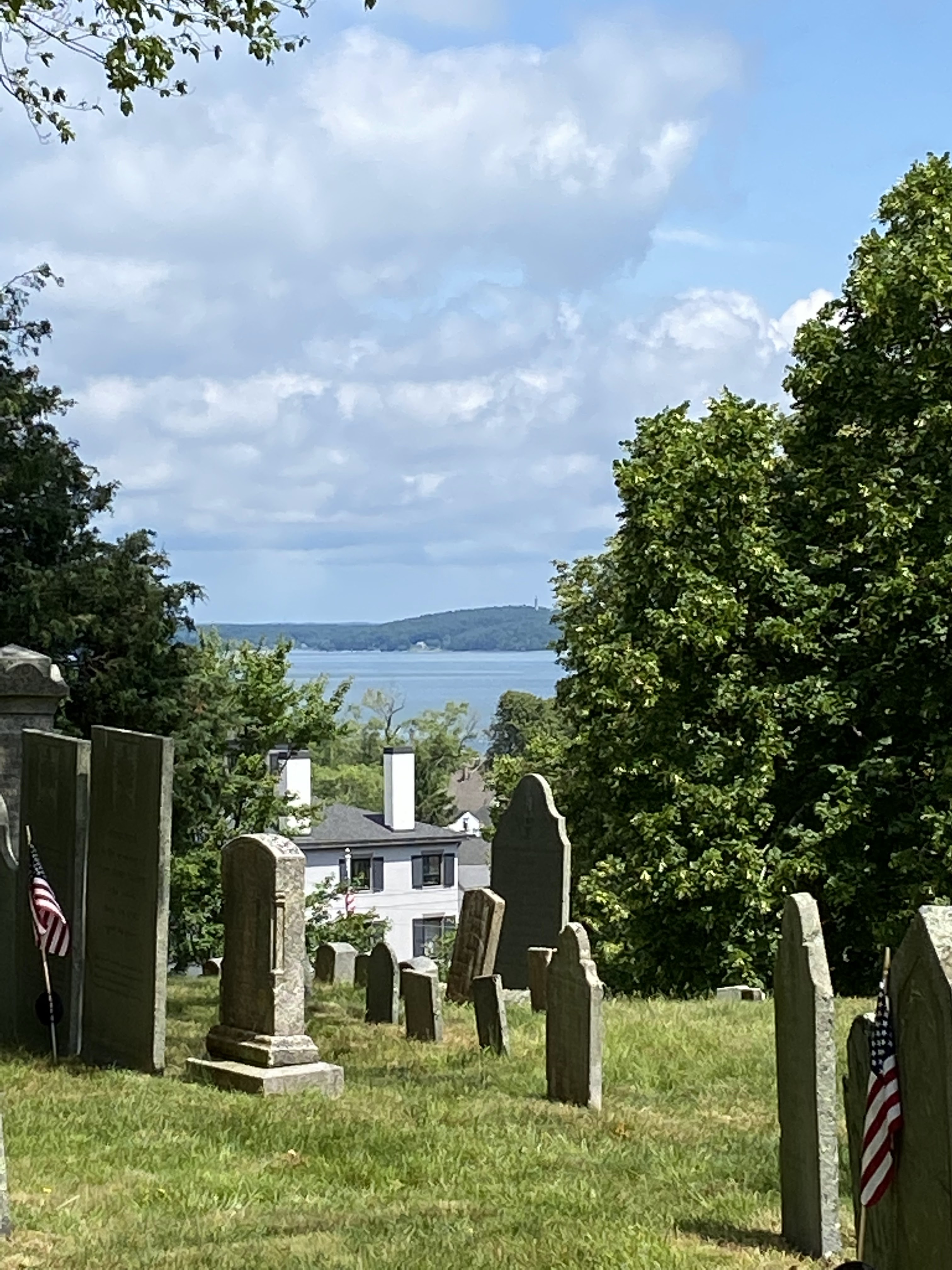 |
| Burial Hill, Plymouth |
The inventory of Nathaniel’s estate was taken in July 1685. It includes books valued at 3 pounds but they are not itemized. Real estate included "House & barne & Cellar & homestead (40 pounds), 20 acre lot between land of George Morton and Joseph Churchell (15 pounds), land below the Kings Road bounded on southeast side by land of Elizabeth Churchell and on northwest by lot called Wellingsly (10 pounds), 11[? ] acres of upland meadows in lower south meadow, two acres meadow in upper south meadows, one acre of fresh meadow in __?__ meadow (14 pounds), parcel lying on easterly side of Assawamsett pond (20 pounds), small lot of land lying on westerly side of Nangakett River together with another parcel lying and Namagakott called "sixteen shilling purchase" (16 pounds), 2 small lots at Ponchatossott (22 pounds), small parcel between the above's homestead and the land of Jno Drewe. Debts due estate included 20 bushels of Indian Corne due from Yarmouth for “salloroy” (3 pounds) and half a year's saloroy due from the County (10 pounds). Ann Morton filed her account on 7 July 1685.
On 20 November 1686 Abram Jackson and Remembrance his wife, George Elliston and Lidia his wife, Isaac Cole and Hannah his wife, Joseph Prince and Joanna his wife "all sons-in-laws and daughters of Mr. Nathaniel Morton late of Plimouth deceased" sold for 28 pounds to George Morton of Plimouth all of the land their father bequeathed to them.
Sources not included above :
Nathaniel Morton, The New-England’s Memorial, or A Brief Relation of the Most Memorable and Remarkable Passages of the Providence of God, Manifested to the Planters of New-England , in America with Special Reference to the First Colony Thereof, Called New Plymouth, 1669
Eugene Aubrey Stratton, Plymouth Colony It’s History and People 1620-1691, 1986
Alicia Crane Williams, Early New England Families 1641-1700, NEHGS Study Project, 2013
Robert Charles Anderson, Mayflower Descendant, “Plymouth Colony Records of Deeds,”vol 39, July 1989
Bradford Kingman, Epitaphs From Burial Hill, Plymouth, Massachusetts, 1892 (Genealogical Publishing Reprint, 1977)

