Welcome! I really enjoy exchanging information with people and love that this blog helps with that. I consider much of my research as a work in progress, so please let me know if you have conflicting information. Some of the surnames I'm researching:

Many old Cape families including Kelley, Eldredge/idge, Howes, Baker, Mayo, Bangs, Snow, Chase, Ryder/Rider, Freeman, Cole, Sears, Wixon, Nickerson.
Many old Plymouth County families including Washburn, Bumpus, Lucas, Cobb, Benson.
Johnson (England to MA)
Corey (Correia?) (Azores to MA)
Booth, Jones, Taylor, Heatherington (N. Ireland to Quebec)
O'Connor (Ireland to MA)
My male Mayflower ancestors (only first two have been submitted/approved by the Mayflower Society):
Francis Cooke, William Brewster, George Soule, Isaac Allerton, John Billington, Richard Warren, Peter Browne, Francis Eaton, Samuel Fuller, James Chilton, John Tilley, Stephen Hopkins, and John Howland.
Female Mayflower ancestors: Mary Norris Allerton, Eleanor Billington, Mary Brewster, Mrs. James Chilton, Sarah Eaton, and Joan Hurst Tilley.
Child Mayflower ancestors: Giles Hopkins, (possibly) Constance Hopkins, Mary Allerton, Francis Billington, Love Brewster, Mary Chilton, Samuel Eaton, and Elizabeth Tilley.

Saturday, August 25, 2012

Thomas Cushman (1637-1726) and Ruth Howland (about 1646-before 1675), Plymouth and Plympton, MA

Thomas Cushman was born about September 1637 in Plymouth, Mass., the son of Thomas Cushman and Mary Allerton. His mother Mary and grandfather Isaac came to Plymouth on the Mayflower. His birth was not recorded, but his father Thomas named him in his 22 October 1690 will. I wrote about Thomas and Mary Cushman here.

On 7 March 1664/5 Thomas Cushman was fined by the Plymouth Court for committing "carnal coppulation" with his now wife before marriage, but after contract.

Thomas married Ruth Howland on 17 November 1664 in Plymouth. Ruth was born circa1646 in Rocky Nook, now Kingston, Mass., the daughter of John and Elizabeth (Tilley) Howland. Both of Ruth’s parents came to Plymouth on the Mayflower.

Recently I toured the Jabez Howland house at Plymouth. Jabez was Ruth’s brother and she certainly would have visited him there. The historic house has a collection of items excavated from the Rocky Nook, Kingston, home of Ruth’s parents. Does anyone else get chills to see items that your ancestors used hundreds of years ago? Thankfully there are organizations like the Pilgrim John Howland Society that do so much work to preserve the memory of our ancestors.
Jabez Howland house in Plymouth

Thomas and Ruth had three children:
Robert born 4 October 1664; m. 1st Persis Lewis and 2nd Prudence Sherman; lived Kingston, MA
Desire born about 1668; m. Samuel Kent; lived Barrington, RI (Desire Cushman was named in her     grandmother Elizabeth Howland’s 17 December 1686 will)
Thomas born about 1670; m. Sarah Strong; lived Lebanon, CT

I descend through Robert and his first wife Persis.

Ruth died before 16 October 1675 when Thomas remarried.  I would guess she is buried at Old Burial Ground (aka Hillcrest Cemetery), Plympton, but her stone has not survived. There is a stone erected to the memory of Ruth and the rest of her siblings at Burial Hill in Plymouth, which I also visited recently.
Memorial marker in memory of Ruth and her siblings, Burial Hill, Plymouth

Thomas married, second, Abigail (Titus) Fuller on 16 October 1675 at Rehoboth, Mass.  They had four children: Job, Bartholomew, Samuel, and Benjamin.

On 16 April 1679 Elder Mr. Fuller and Brother Thomas Cushman were chosen to attend the ordination of Mr. Samuel Angier at the Rehoboth Church. On 24 October 1694 Thomas again went with the pastor to the ordination of Mr. Thomas Greenwood at the Rehoboth Church. On 11 September 1692 the church met to consider names of men who could read the psalms during Deacon Faunce’s illness, and Thomas Cushman was one of the men chosen. It seems that Thomas's earlier misstep did not hurt his standing in the church, although he did not reach the level of his father as Ruling Elder of the Church or his brother Isaac who was a minister.

Thomas Cushman was on the list of members of the Plymouth Church on 10 March 1703 with a notation he was dismissed, but does not say to what church.

On 1 March 1714/15 Thomas Cushman of Plympton sold land to his son Robert Cushman. On 22 June 1715 Thomas Cushman of Plympton, yeoman, sold land to son Job Cushman.
 
On 21 May 1721 Thomas Cushman of Plimpton, yeoman, deeded to son Benjamin the house and land where Benjamin was living. On the same day he deeded to son Samuel the land where Samuel was living. On 25 Dec 1721 he deeded the land where he himself was living to sons Benjamin and Samuel.

 Thomas died 23 August 1726 at Plympton, Mass. He was age 80 “wanting a month.”  He is buried at the Old Burial Ground in Plympton, but his gravestone is worn and difficult to read. 
.
Here Lies ye Body of Mr. Thomas Cushman
Dec Augst ye 23rd ______________________


No Plymouth County probate has been found for Thomas.


Sources Not Listed Above:
Eugene Stratton, Plymouth Colony, It's History and People, 1986
Robert S. Wakefield and Margaret Harris Stover, Mayflower Families Through Five Generations, Isaac Allerton, Volume 17, compiled by, Published by GSMD, 1998
Ann Smith Lainart and Robert Wakefield, Mayflower Families Through Five Generations, John Howland, Vol 23, Part 1, GSMD, 2006

Sunday, August 19, 2012

Eleazer Kelley (1697-1775) and Sarah Browning (1694-?), Yarmouth, Mass.


 Eleazer Kelley, my sixth great-grandfather, was born in Yarmouth (now Dennis), Mass., on 5 March 1696/97, the son of Jeremiah and Sarah (Chase?) Kelley. I wrote about Jeremiah here. Eleazer is spelled in a variety of ways including Eliezer and Eleaser. Kelley is seen spelled as Killey, O’Kelley, O’Killey, O’Kelia and O’Celley.

Eleazer married on 6 October 1721 in North Kingstown, Rhode Island, Sarah Browning. Sarah was born April 1694, probably in North Kingstown, RI, the daughter of William and Sarah (Wilbore) Browning. North Kingstown was the home to early Quakers.
North Kingstown, RI

Eleazer and Sarah had four children (first two recorded Yarmouth VR; rest named in father’s will):

Patrick, born 20 February 1722/23; married Bethia Baker and Betsey Nickerson
Eleazer, born 1 November 1728; married Hannah Baker
Sarah, born 1730; m. Abner Crowell who served in the Rev War and died a prisoner of war
Benjamin, born about 1735; m. Susannah Davis
I descend through Eleazer as well as Patrick (and his first wife Bethia).

Sarah died before 20 August 1748, when Eleazer’s intentions to marry Phebe Baker were recorded at Yarmouth. He and Phebe were married on 8 September 1748.

Eleazer and Phebe had one child, Phebe, born about 1749 who married Ebenezer Chase.

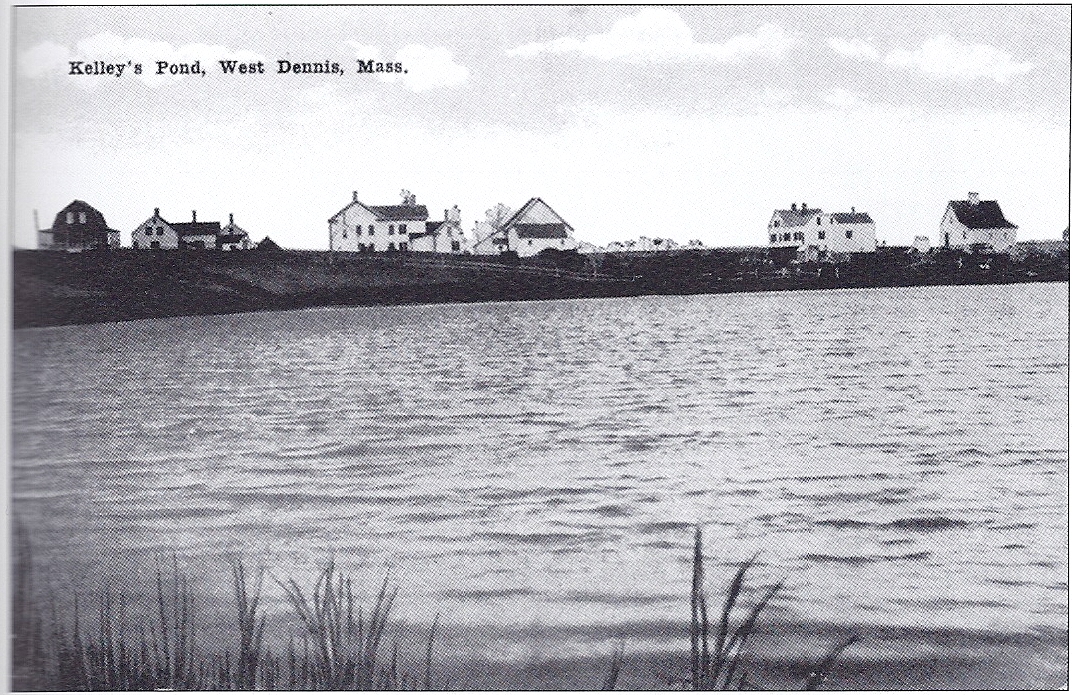
I don't know exactly where Eleazer's homestead was located, but since his father owned a large amount of current day West Dennis, I would think Eleazer lived there. His will mentioned woodland near Bass River as well as pond rights. He may have been referring to Kelley's Pond in West Dennis. Something I need to investigate further.  
A beautiful old postcard showing Kelley's Pond
Old snapshot of Bass River


Eleazer died 5 October 1775 at Yarmouth (now Dennis), Mass. In his death record, he is listed as “Frend,” referring to his being a member of the Society of Friends (aka Quaker). I don't know where Eleazer and his wives were buried, but perhaps they are interred at the Quaker Cemetery on Mayfair Road in Dennis where there are very few gravestones.
Quaker Cemetery


“Eleaser Okilly” of Yarmouth wrote his will on 4 July 1775.  Misspellings and grammatical mistakes as per original: "Debts & funeral charges to be paid out of money and not land. To wife, Phebe: east most room in my house and pond rights as long as she remain my widow, all indoor moveables given to her by her father for her to have forever, following household moveables while she remain my widow; twelve bushels Indian corn, four of rye, four gallons malasses, eight cord wood fit for fireing, red spotted cow, half of my swine, my best iron pot, iron pudding glass, tea kettle, two pewter spoons, two forks, two knives, frying pan. To son, Paddrick: two silver spoons, six shillings. To son, Eleaser, six shillings. To son, Benjamin: twelve acres of woodland that adjoins to his wood land on the West side of Bass River so called, two silver spoons, six shillings. To daughter, Sarah Crowel: half of my indoor moveables not before disposed of excepting one bed for my grandson Browning that he lodges on now, six shillings. To daughter, Phebe Chase: remainder of indoor moveables, one cow, three pounds, if my wife takes up with what I gave her in lieu of her thirds, if wife refused, then my daughter Sarah Crowell shall have the whole of my daughter Phebe Chase's portion except six shillings. To grandson, Eleaser Killey: half my farm where I now dwell with half buildings on the same, the true meaning is that he is to have half of all buildings, woodland, cleared land, meadow, swamp, swampy ground, which has not been previously disposed of, my house, all my wearing apparell, great Bible, walking cane, two silver spoons, as to the real estate I give to my grandson Eleaser Killey to improve during his lifetime and after his decease my will is that his eldest living son may have the real estate during his life to improve, then to his heirs forever. To grandson, Browning Killey: the other half of my farm whereon I now dwell and half of all buildings on the same, half of all buildings, woodland, cleared land, meadow, swamp, swampy ground, which has not been previously disposed of, half swine, privilege of lodging on one bed so long as he is single, as to the real estate I give to my grandson Browning Killey to improve during his lifetime and after his decease my will is that his eldest living son may have the real estate during his life to improve, then to his heirs forever. If either of my two grandsons, namely, Eleaser & Browning decease without heirs then his part according to my will must return to his living brother; both grandsons to provide for my wife so long as she remain my widow. To son-in-law, Abner Crowel's children, namely: Abner Crowell, Silvanus Crowell, Heman Crowell, Eleaser Crowell, Judah Crowel & Sarah Crowel, 7 pounds:1:6, to be equally divided between them." Executor was to be Benjamin Killy. Witnesses were Hattil Killy, Edward Crowel Jr, and Michael Crowel. The will was proved 6 Dec 1775 (Barnst Co. Probate 17:309-12). The inventory was taken by Timothy Baker, Judah Baker and David Killey Jur, and recorded 8 Dec 1775, totaling 354:19:5 (same as above, p 326).
 

Sources Not Listed Above:

R. Dudley Kelley, David O’Killea of Yarmouth, Massachusetts and some of his Descendants, NEGHR April 1997
Edward Franklin Browning, Genealogy of the Brownings in America from 1621 to 1908, 1908


Saturday, August 11, 2012

Francis Billington 1606-1684, England>Plymouth>Middleboro Mass.

Francis Billington was born ca 1606 in England, possibly the Lincolnshire area, the son of John and Eleanor (______) Billington. He was a boy of about 14 when he came to America on the Mayflower with his parents and younger brother John. I’m quite taken by the Billingtons’ colorful ways—they were a raucous family by Pilgrim standards, sometimes referred to as America’s first dysfunctional family, and caused a lot of headaches for the leaders. Every group needs some rabble rousers to question authority!

Gov. William Bradford referred to them as profane and father John was often at odds with the settlement leaders. He was obviously one of the “strangers” on the voyage—rather than part of the “saints” who settled Plymouth for religious freedom. John’s journey to the new world ended when he was executed for murder in 1630. I wrote about John here.
Site where the John Billington family lived in Plymouth

The apple doesn't fall far from the tree, as Francis developed an early reputation as a troublemaker. When the Mayflower was anchored off Provincetown, he fired off a musket in his family's cabin that nearly ignited a barrel of gunpowder which would have destroyed the ship and everyone aboard.

When the group landed at Plymouth, Francis Billington climbed a tree on Fort Hill and saw what appeared to be a great sea. No one seemed to take his claim seriously, but eventually one of the ship's crew accompanied him to take a look. What they found wasn’t the sea, but a lake of about five miles in circumference, which to this day is called the Billington Sea.  The lake, with its vast amount of fish and fowl, must have been a great help to the settlement.
Billington Sea Postcard

Francis’s brother John also gave the Pilgrim leaders some headaches. In July 1621, the 16 year old lost his way in the woods. For five days he wandered aimlessly until he stumbled on the Indian village of Manomet, some 20 miles from Plymouth. He was passed onto the Nausets of Cape Cod, who had attacked the Pilgrims during the first encounter back in December and from whom the Pilgrims had taken corn and disturbed graves. When he heard of the news, Bradford ordered a party of 10 men to go for the boy with Squanto and another Indian as guides. They met with the Nausets in present day Eastham and promised to replenish their corn. More than 100 warriors armed with bows and arrows watched the discussion and John was carried in one of the men's arms, looking none the worse for wear, wearing a string of shell beads around his neck. The Nauset sachem Aspinet was presented with a knife and peace was declared.
 Francis married at Plymouth, in July 1634, Christian (Penn) Eaton (widow of Francis Eaton of the Mayflower). Christian was born in England about 1607, the daughter of George and Elizabeth (_____) Penn. She came to Plymouth in 1623 on the ship Anne.
Plaque at First Encounter Beach

Their children were all born at Plymouth:
Elizabeth b. 10 July 1635, married Richard Bullock, Robert Beere (killed during King Philip’s War), Thomas Patey (drowned on Seekonk River).
Joseph b. before 2 Feb 1636/7, married Grace _____.
Martha b ca 1638, m. Samuel Eaton, Robert Crossman.
 Mary b. ca 1640, m. Samuel Sabin.
Isaac b. ca 1644, m. Hannah Glass.
 Child b. ___ and died young.
 Rebecca b. 8 June 1648 and evidently died young.
Dorcas b. ca 1650, m. Edward May.
Mercy prob. as an unnamed daughter 25 Feb 1651/2, m. John Martin.

I have two Billington lines, one through their daughter Martha (and first husband Samuel Eaton) and another through son Isaac.

When Francis married Christian, he took responsibility for the three Eaton children, one of whom Gov. Bradford described as "an idiot," but who lived until 1651, presumably at home.

Francis was not made a Freeman at Plymouth. Possibly he never joined the church or paid the price for his family’s undesirability.

In 1642 Francis and Christian Billington "put Elizabeth, their daughter, apprentice to John Barnes and Mary, his wife, to dwell with them and to do their services until she shall accomplish the age of twenty-three years (she being now seven years of age...)" Their son Joseph was already living with John Cooke and in trouble with the court because he kept running away and going home. The court ordered that for every time he did this, Francis and Christian would be put in the stocks. Also, if 14 year old Benjamin Eaton (Christian's child from first marriage) enticed Joseph to run away, he would be put in stocks also. Their daughters Mary and Martha may have also been put out to other families.

This practice of putting out children occurred on a fairly regular basis in Plymouth. In part it may have roots in an English custom that dated back at least to the 16th century, when children were brought up in families other then their own due to the belief that they would learn better manners than at home. It also may have had to do with economic hardship of many families and the shortage of cheap labor. Children were apprenticed to learn a trade, obtain a general education in the household, or were simply servants. Some children put out were from reasonably well-off, educated famlies, some were orphans, others from homes where economic hardship necessitated it.

Francis received land from his mother, Eleanor Billington, widow, on 8 Jan 1637/8 for "natural love I bear unto Francis Billington my natural son." She conveyed to him all her land at Plain Dealing in New Plymouth, reserving enough of the land for her own use during her lifetime.

Francis and Christian lived at Plymouth until 1669, when they moved to Middleboro and occupied land granted to Francis as one of the "First Comers." They lived there until their deaths, except for a few years during King Philip's War when the family fled to Plymouth for safety.

Francis died at Middleborough in Plymouth Colony on 3 December 1684. The Middleborough records state he was 80 years of age, but an earlier deposition gives him a birth year of 1606, so he would have died at 78.  Christian likely died the same year.

In his old age Francis was dependent on his son Isaac for support and died intestate. No probate record appears, although son Isaac petitioned the court in 1703/4 for title to all his father's Middleboro lands, stating he had, for seven years, sole care of his parents in their old age, which indicates Francis and Christian died around the same time.

A Plymouth County Court case of Sept 1722 brought by Isaac's daughter Desire (Billington) Bonney and her husband, James, shows that Francis died leaving issue of two sons and five daughters, viz sons Joseph and Isaac, daughters Elizabeth, Mary, Dorcas, Mercy and Martha. There was a total of 8 shares in the estate, with a double portion for Joseph as the eldest son. A 1719 quitclaim deed from Francis's grandson Francis Billington, reading "my father Francis and grandfather (unnamed) Billington" seems to imply a son Francis Jr, but in the absence of any mention of such a son in Plymouth records, it appears the deed was a clerical error. Original must have read "my father Joseph and grandfather Francis Billington." Indications are that the seven children named in the Bonney suit and their progeny were the only survivors of Francis.

Sources Not Listed Above:

Eugene Stratton, Plymouth Colony, It's People and History, 1986

Mourt’s Relation, 1622

James and Patricia Scott Deetz , The Times of Their Lives: Life, Love and Death in Plymouth Colony, 2001

Harriet Hodge, Mayflower Families Through Five Generations," Volume Five, Edward Winslow and John Billington, published by the General Society of Mayflower Descendants, 1997

Nathaniel Philbrick, Mayflower: A Story of Courage, Community and War, 2006