Welcome! I really enjoy exchanging information with people and love that this blog helps with that. I consider much of my research as a work in progress, so please let me know if you have conflicting information. Some of the surnames I'm researching:

Many old Cape families including Kelley, Eldredge/idge, Howes, Baker, Mayo, Bangs, Snow, Chase, Ryder/Rider, Freeman, Cole, Sears, Wixon, Nickerson.
Many old Plymouth County families including Washburn, Bumpus, Lucas, Cobb, Benson.
Johnson (England to MA)
Corey (Correia?) (Azores to MA)
Booth, Jones, Taylor, Heatherington (N. Ireland to Quebec)
O'Connor (Ireland to MA)
My male Mayflower ancestors (only first two have been submitted/approved by the Mayflower Society):
Francis Cooke, William Brewster, George Soule, Isaac Allerton, John Billington, Richard Warren, Peter Browne, Francis Eaton, Samuel Fuller, James Chilton, John Tilley, Stephen Hopkins, and John Howland.
Female Mayflower ancestors: Mary Norris Allerton, Eleanor Billington, Mary Brewster, Mrs. James Chilton, Sarah Eaton, and Joan Hurst Tilley.
Child Mayflower ancestors: Giles Hopkins, (possibly) Constance Hopkins, Mary Allerton, Francis Billington, Love Brewster, Mary Chilton, Samuel Eaton, and Elizabeth Tilley.

Saturday, January 18, 2025

Samuel Ryder 1601-1679 of Buckinghamshire England and Yarmouth/Dennis Massachusetts and his wife Anne Gamlett

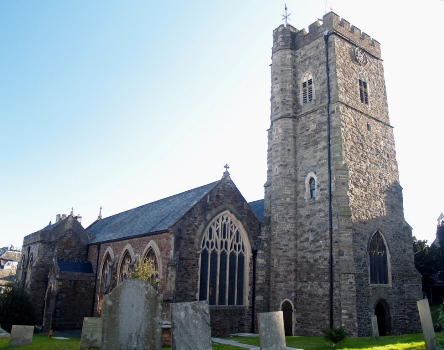
Samuel Ryder (often seen as Rider) was baptized 19 June 1601 at Newport Pagnell, Buckinghamshire, England, to John and Helen (Smith) Ryder. [Rider, citing Newport Pagnell Church Register] The only church I find that existed at this time in the town is St. Peter and St. Paul, built in the 14th century.

St. Peter and St. Paul, Newport Pagnell

There has been a great deal of misinformation about Samuel and his descendants in print and online. Fortunately George Bowman, late editor of the Mayflower Descendant, devoted much time and print space to straightening things out. One book where he found many errors is The Pioneers of Massachusetts by Charles Pope.


Samuel Rider married Ann/Anne Gamlett on 16 October 1628 at All Saints Church, Northampton, Northamptonshire, England. [Rider, citing registers of All Saints Parish, Northampton 1560 to 1642] Anne was born about 1608 in England; her parents not yet discovered. Genealogist Richard Rider did not find any other Gamlett records in the area and he believes her name may have been Gauntlett or Gantlett. Anne and Samuel are my 11th great-grandparents on my grandmother Milly (Booth) Rollins’ side of the family.


He is called labourer and maltster (malt was used in brewing beer) in the English records of his children’s baptisms and a land record concerning his son Samuel.


The Rider/Ryder name appears infrequently in Northamptonshire records. Richard Rider’s research shows that the Samuel of Northampton is the Samuel of Yarmouth, Massachusetts. There are deeds involved his son Samuel Jr. who is called “sonne of Samuel Ryder Sr sometimes lived in the Towne of Northampton”  and that Samuel and his father lived in the Township of Yarmouth in the jurisdiction of Plymouth. [Register 79:316 at the Northampton Public Library] Samuel Jr. received a bequest of land from his godfather John Smith of Kingsthorpe in 1637, a relationship to be further explored. A 3 December 1662 document signed by William Collier, Deputy, and Thomas Southworth, Assistant, of Plymouth in reference to a conveyance of this Kingsthorpe land states that Samuel Rider of Plymouth, son of Samuel of Yarmouth, had both lived in the colony for about 30 years.  Samuel Sr is called a “moultster” in the documentation concerning this conveyance. 


Samuel was almost certainly a dissenter, which would be a major reason for him to emigrate to New England. He left England with his wife and their three young children Samuel, Jane, and John after the December 1636 baptism of John in Northampton but before 7 January 1638/9 when Samuel was one of  nine men granted permission to “take up their freedome at Yarmouth.” [Hollick] [PCR 1:108] It is said that their son Zachariah was the first white child born there but I am not certain of that. [Stevens] This area of Yarmouth is now located in Dennis which was founded in 1793. Yarmouth is now in Barnstable County, Cape Cod, but at the time Samuel lived there it was part of Plymouth Colony. 


Children of Anne and Samuel [All Saints baptisms/burial from Rider, citing church registers, 1560 to 1642]:


  1. Jane Rider bp All Saints, Northampton, 4 October 1629; buried there 5 September 1631 
  2. “Parvulus” [Latin for baby] Rider born 1630-31; buried All Saints 27 August 1631 [he was less than a year old, but likely a newborn since no name is given]
  3. Samuel bp All Saints 25 November 1632; married 1st 23 December 1656 at Plymouth Sarah Bartlett, daughter of Richard Bartlett and Mary Warren and granddaughter of Mayflower passenger Richard Warren; married 2nd Lydia Tilden, daughter of Thomas Tilden and Elizabeth (Bourne) on June 14, 1680 at Taunton; he died 18 July 1715
  4. Jane bp 23 November 1634 at All Saints; living in November 1679 when her father wrote his will; NFR
  5. John bp All Saints 4 December 1636; married but wife’s name unknown 
  6. Zachary/iah was born at Yarmouth about 1638; married Mary —-; killed by the accidental discharge of a gun during Yarmouth military training in 1685
  7. Benjamin born Yarmouth say 1640; married Mary Gray on 13 June 1670  
  8. Elizabeth born about 1642 at Yarmouth; married John Cole 21 Nov 1667 at Plymouth; alive at time of her father’s will 
  9. Joseph was born about 1644 at Yarmouth; married 1st a woman whose name is not recorded; he married 2nd Sarah Matthews, widow of Thomas Matthews of Yarmouth. 
  10. Mary was born 6 September 1647 at Yarmouth [MD 15:26]; named in father’s will; NFR


I descend from John. 


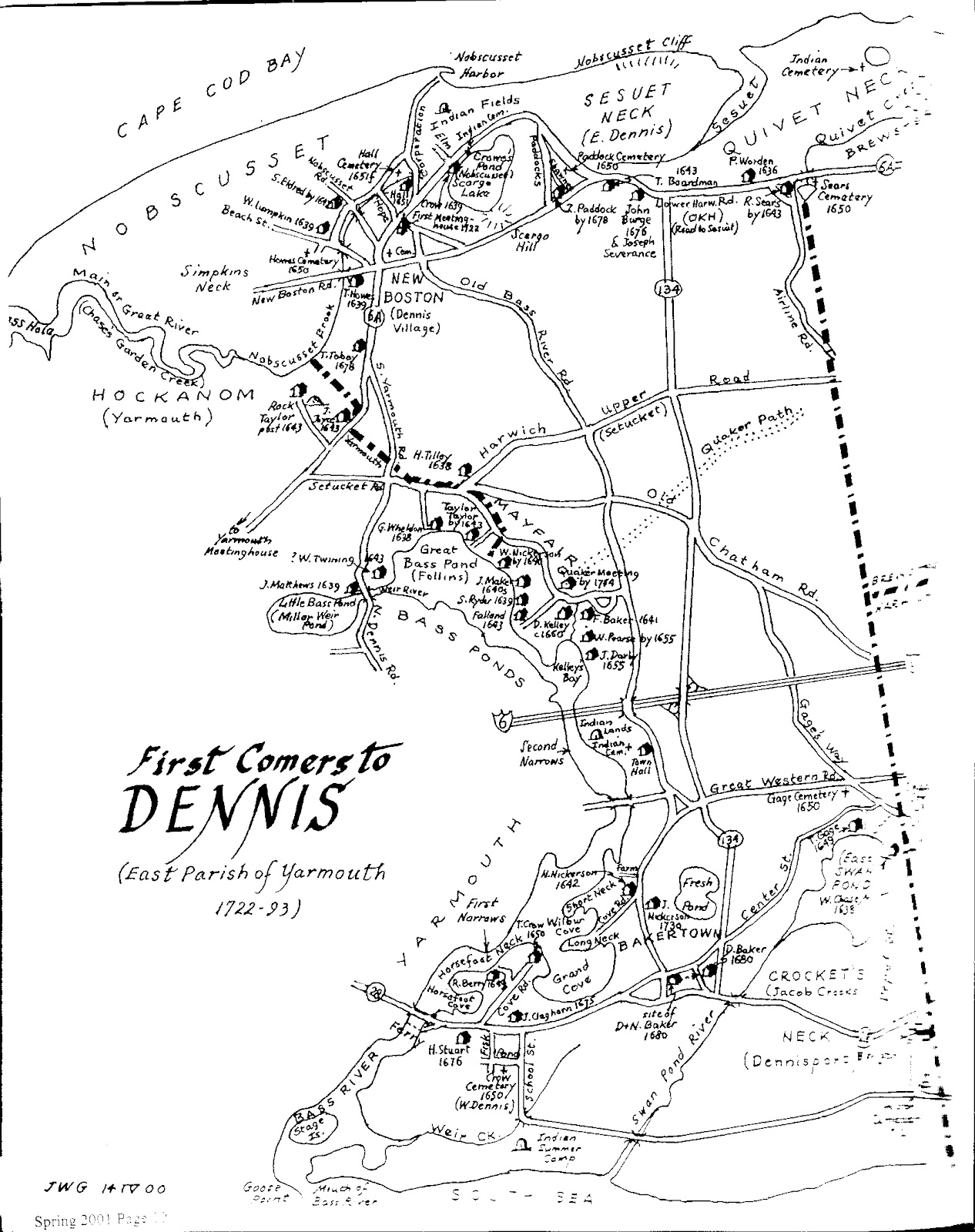
This large family lived on the west side of Bass Pond, later Follins Pond, near the headwaters of the Bass River. The land was fertile and there was an abundance of herring and perch. The homestead was located on what is now on Edgemere Road in the Mayfair neighborhood of Dennis. [CCGS Bulletin Spring 2001] 


Samuel's homestead located near Mayfair Rd (source: CCGS Bulletin Spring 2001)

Samuel served on juries and was appointed to various committees. He was surveyor of highways (1653, 1666), Deputy to the General Court at Plymouth [1653], Yarmouth constable (1663), collector of Minister’s Tax [1671] and one of three makers of a tax rate to fund the expenses of the war [1676]. In 1658 he was a member of the Council of War. He was taxed £5 2 shillings pence towards King Philip’s War in 1676. He was on the 1657 list, as Samuel Rider Senior, of Yarmouth men who had taken the oath of fidelity. [PCR 8:185] He is listed on the colony’s 1643 list of Yarmouth men able to bear arms. [Shurtleff 194]


Samuel was active in the Yarmouth militia:

  • On 10 October 1643 Samuel was appointed by the court to a committee to select a place to fortify for the general defense in the event of a sudden assault. [Hawes] 
  • He is called Sergeant when he was appointed Deputy to attend a military council at Plymouth in June 1653, necessary because of the dangers of a war between England and Holland. 
  • In 1654/5 he was removed from this rank because of the abusive language he used towards constables who were sent to press men into service. Likely reason for his being reduced to the rank of common soldier was his leniency  towards the Quakers.  [Swift’s History of Old Yarmouth] 
  • He was re-appointed Lieutenant on 1 June 1658. [Stratton]
  • In March 1683/4 the land of "Leift Ryder Deceased" is mentioned.

The Mayfair area where Samuel lived was settled mostly by Quakers but it seems unlikely Samuel was of that faith since he was an officer in the militia and held town offices. 


In his 20 November 1679 will, Samuel Ryder mentions wife Anne, sons John, Benjamin, Samuel, Zachary, and Joseph, daughters Jane, Elizabeth, and Mary. Unfortunately he does not mention his daughter’s surnames. 


”The last Will .... of Samuell Ryder senir of Yarmouth late Deceased exhibited to the Court held att Plymouth ...; the 2cond of March Anno: Dom 1679:80: on: the oath of Mr John Thacher as followeth "In the Name of God Amen this 20th Day of November one thousand six hundred seaventy nine: I Samuell Ryder of Yarmouth .... my Will is that Anne my loveing wife shall have and Injoy all my Estate both housings and lands and Movables .... During her Naturall Life or state of Widdowhood shee paying my Just Debts and Discharging my buriall; and after the Decease of my loveing wife I Doe Give .... all my housing and lands and meddowes whersoever, belonging or Acrewing to mee; To my son Benjamine .... except that prsell of Planting land in the prime ffeild, which I Doe Give, to my son John During his Naturall life; And then to Returne to my son Benjamine .... and incase that my son Benjamine Die without heire Naturally begotten of his body; Then all my housing, land and Meddows To fall and belonge unto the Next heire male, of my family, alsoe .... Samuell my son shall have five shillings of my estate, And alsoe .... my Daughter Jane shall have three Cowes to be payed in three yeers; after my Decease, that is one Cow in each yeer; and alsoe to my Daughter Elizabeth I Doe Give ten shillings; alsoe I Doe Give to my Daughter Mary ten pounds; to be payed in Currantpay within three yeers after my Decease; And alsoe I Doe Give to my son Zachery twenty shillings; and to my son Joseph I Doe Give twenty shillings; I Doe by this my last Will .... Appoint my Loveing wife Anne and my sonne Benjamine sole executors .... I Doe alsoe Request my trusty and welbeloved frinds Mr Edmond Hawes, and John Thacher to be helpfull to my Executors, as Need may Require, Concerning this my Last Will"

Witnessed by Edmund Hawes and John Thacher. Sworn to by Edmund Hawes 25 February 1679, before Thomas Hinckley, Assistant.  [The Mayflower Descendant 11:50-51 (1909), citing Plymouth Colony Wills, 4:1:45]


Samuel Ryder died 2 December 1679, age 78, at Yarmouth. He is called “Junior” in the record but this must be a transcription error as the date matches perfectly with the date of his will and his age is a match as well. [Yarmouth VRs 1:125]


The inventory of Samuel Ryder’s estate was taken 9 December 1679 by Edmund Hawes and John Miller. It totaled £237 10 shillings. Among the items were: "10 shoates Benjamine Ryder Claime the halfe” [shoat is a young, usually weaned, pig] "4 piggs Benjamine Ryder Claimeth half of them" "I Dwelling house barne upland and meddow 150 00 0” [MD 11;51]

"Anne the Relict of the abovemensioned Sam:ell Ryder made oath to the truth of this Inventory The 17th of January 1679 before mee Thomas Hinckley Assistant"

[MD 11:51]


Anne Ryder died 14 December 1695 at Plymouth recorded as “An rider the mother of Samuel Rider deceased.” Samuel died in 1715 so perhaps the record should read wife or widow of Samuel Rider which would be expected. She was likely living with her son Samuel and his family in Plymouth as she was quite aged, about 87 years old. [Plymouth VR 135]


Sources:

Nancy Thacher Reid, Dennis Cape Cod From Firstcomers to Newcomers 1639-1993, 1996

Richard G. Rider, The American Genealogist, “Rider Notes: The European Generations,” 43:120-21 (1967)

Marion Vuillieumier, The Town of Yarmouth Massachusetts: A History, 1989

Eugene Stratton, Plymouth Colony, Its History and People, 1986

Cape Cod Genealogical Society Bulletin, Spring 2001, page 8-10, map showing locations of homes of "Dennis First Comers”

Charles W. Swift, History of Old Yarmouth, 1884

Torrey’s New England Marriages Prior to 1700, pg. 625

Charles W. Swift, Library of Cape Cod History and Genealogy, No. 66 "The Rider Family of Yarmouth,” 1913

James W. Hawes, Library of Cape Cod History and Genealogy, No. 98, "Ryder Genealogy,” 1912

Simeon Deyo, editor, History of Barnstable County, Massachusetts, 1890

Martin E. Hollick, NEHGS Register, “The John Riders of Yarmouth, Massachusetts,” 80:128-139 (2005)

Torrey’s New England Marriages to 1700, 2:1276

Percival Hall Lombard, Mayflower Descendant, “The Seal of the Plymouth Colony,” 29:6

Robert Croll Stevens, Ancestry of the Children of Robert Croll Stevens and Jane Eleanor (Knauss) Stevens, Vol. II: The Genealogy of John Christian Croll 1707-1758, 1985

Nathaniel Shurtleff & David Pulsifer, eds., Records of the Colony of New Plymouth, in New England, 12 volumes, pub. 1855-1861

Saturday, January 11, 2025

Edmond Lewis, about 1601 to 1651, of England and Watertown & Lynn, Massachusetts

Edmond Lewis was born England about 1601, based on his age when he sailed for New England. His birthplace and parents have not been found; some have said he was from King’s Lynn in Norfolk, others from Suffolk or Wales, but nothing conclusive. His last name is sometimes spelled Lewes and first name Edmund. 

By 1630 (first child born about 1631) he married a woman named Mary whose maiden name is unknown. She was a born about 1602 in England, based on her age in 1634. 


Migration


On 30 April 1634, “Edmond Lewis,” aged 33, “Mary his wife,” aged 32, “John Lewis,” aged 3, and “Thomas Lewis, aged 3 quarters,” were enrolled at Ipswich as passengers for New England, sailing on the Elizabeth. [Hotten 280-81]. They first resided at Watertown in Middlesex County where he was admitted a freeman on 25 May 1636. [Mass Bay Colony Records 1:372] His homestead was on the east side of Lexington Street in Watertown. [George Harlan Lewis]


The Lewis family removed to Lynn in Essex County by 29 December 1648 when Edmond served on an Essex grand jury. [Records and Files of the Quarterly Courts of Essex County/EQC 1:160]. He was on a petit jury 31 Dec 1650 [EQC 1:204] and named Lynn constable 27 June 1649 [EQC 1:170]. They lived on what is now Lewis Street. [George Harlan Lewis] 


George Harlan Lewis wrote Edmond purchased 40 acres of land on Lynn’s seashore and he also proposes Edmond may have been a sailor given the location of his land and the weapons he owned. His sons Nathaniel and Joseph were mariners. Edmond’s WikiTree profile has a map showing the location of his farm here.


Family


Mary and Edmond had seven children, most or all of them boys. 


i. John Lewis born England about 1631 (age 3 on 30 April 1634); married 1) at Lynn 17 June 1659 Hannah Marshall (his name given incorrectly as Jonathan); married 2) Lynn (int) 2 September 1699 Elizabeth (Walker) King, daughter of Richard Walker and widow of Ralph King; married 3) Lynn 10 February 1706/7 Sarah (Merriam) Jenks daughter of William Merriam and widow of John Jenks.  (Essex Institute Historical Collections 43:74). He was an innkeeper, a deacon and served in King Philip’s War. 

ii. Thomas Lewis born England about July 1633 (“aged 3 quarters [of a year]” on 30 April 1634 [Hotten 281]); married 11 November 1659 Hannah Baker at Lynn. He was a builder.

iii. James Lewis born Watertown 15 January 1635[/6] [Watertown VR 4]; presumably one of the “five youngest” children named in Edmond’s 1650/1 will; no further record.

iv. Nathaniel Lewis born Watertown 25 August 1639 [Watertown VR 6]; married by 1672 Mary ___ (eldest known child b. Swansea 6 June 1672 [Swansea VR 8]).

v. Child Lewis, born 27 October 1642 [calc]; died 6 November 1642, “10 days old” (Watertown VR 10]

vi. Child Lewis, born say 1644; presumably one of the “five youngest” children named in Edmond’s will; no further record.

vii. Joseph Lewis born say 1646; married Swansea 13 June 1671 Mary Jones [SwVR 23], daughter of Robert and Ann (Bibble) Jones [The American Genealogist 31:98-99]. He was reportedly the first white man slain in King Philip’s War at Swansea 24 June 1675. Note: Some researchers believe the evidence is flimsy for Joseph as a son of Edmond and Mary, but there are Swansea land records where he is called a brother of Nathaniel Lewis. 


Only the eldest son John is given by name in his father’s 1651 will. Presumably Thomas, James, Nathaniel,  Joseph and a child whose name is unknown are referred to as Edmond’s five youngest children.  I descend from Thomas whom I wrote about here.


Public service


Edmond was elected a Watertown selectman on 30 December 1637 [Watertown Town Records 1:3]. He was named to a committee to lay out farms on 14 October 1638 [Watertown Town Records 1:4].


It seems Edmond served in the militia as his inventory included “a sword, belt & bandoliers” valued at 12s., “two muskets & two rests” valued at 1 pound 16 shillings, “a fowling piece” valued at 1 pound 6 shillings, and “two small guns’ valued at 16 s [Essex County PR 1:124].


Edmond was literate as he signed his will and his inventory included a Bible. [Essex Probate Records 1:125].


Land transactions


On 25 July 1636 Edmond Lewis was granted 30 acres in the Great Dividend in Watertown, Lot No. 26 in the First Division. [Watertown Lands, Grants, Divisions, Allotments, Possessions and Proprietors’ Book 3/WaBOP]  Granted five acres in the Beaverbrook Lowlands lot no 82 on 28 February 1636/7 [WaBOP 7]. Granted five acres in the Remote Meadows lot no 61, on 26 June 1637 [WaBOP 9]. Granted six acres in the Town Plot on 9 April 1638 [WaBOP 11].


In the Watertown Inventory of Grants “Edmond Lewis” held six parcels [WaBOP 29]:

“An home stall of six acres”

“One acre of meadow in Rock Meadow”

“Thirty acres of upland being a Great Dividend in the 1 Division & the 25 lot”

“Five acres of Plowland in the Further Plain & the 91 lot”

“Five acres of meadow in the Remote Meadows & the 61 lot”

“A farm of one hundred acres of upland” 


On 16 Oct 1644 “John Sanders of Hampton” sold to “Henry Dow & Edmund Lewis of Watertowne…all the ground that I bought of William Wakefeild of Newbury which is to say one houselot containing ten acres…with ten acres added to the same adjoining to the north end thereof and twelve acres of planting ground granted in the east field and ten acres of meadow ground granted in the east field and ten acres of meadow ground adjoining to the springs and seventeen acres of salt marsh near adjoining to it together with the commonage & appurtenances to the same belonging” [Ipswich Land Records 1:18] On 22 October 1649 “whereas we Edmond Lewis & Henry Dow as joint purchasers in a bargain of land which he bought of John Sanders of Hampton, the land lying in the bounds of Hampton,” now “Edmond Lewis of Linn” sells to Henry Dow his entire right in the said lands [Old Norfolk County Deeds 1:10].


On 23 Oct 1645 “Edward Lewis of Watertowne” sold to “Daniel Smith of Watertowne one acre of meadow in Rocky Meadow” [Suffolk Deeds 1:64]. On 28 December 1647 Watertown selectmen “ordered that John Sherman shall measure the acre of meadow that was given Edmund Lewes” [Watertown Town Records 1:11]. It seems Edmond was contemplating a move to Hampton (now in New Hampshire) as Dow moved there almost immediately but it seems Edmond did not move there.


Death & Probate


Edmond died between 13 January 1650/51 (when he wrote his will) and 12 Feb 1650/51 (will proved), at Lynn. He was about 50 years old. Mary, widow of Edmund Lewis, late deceased, brought in his will 12:12:1650 [12th month was then February], and it was proved by Edward Burcham and John Deacon. Ordered that the children receive their portions at the age of 21. Inventory of the estate of Edmund Lewis of Lynn, deceased, taken 12 February 1650 by John Deakin, James Axey, witnessed by Edward Burcham and William Tilton (his mark). The inventory, which contained no real estate, totaled  £122 7 shillings 6 pence. [Essex Antiquarian 7:27]


Edmond’s will dated 11th month [January] of 1650/51: ”Line [sic: Lynne] the 13th of the 11th mo 1650 Memorandum that I Edmund Lewis beinge Sick & Weake, but of perfect remembrance, doe make & confirme this my last Will and testymente as followeth first my will Is that my land att watertowen shall be sould & thatt my eldeste sone John Lewis shall have A double portyon & yt the reste of my Children namly the five youngeste to haue every one of them A licke portyon of my estate secondly my deare & Lovinge wife to have the thirds of All my whole estate 3 I desier that my wife may have A cow over & above towards the bringine upe of my youngeste Children 4 my desires Is my wife to be my whole Executor to dispose of my body & goods ackordinge to my will 5 my requeste to my sone John Is to give his mother a Cow to hellpe her towards the bringine upe of my youngeste Children 6 my requeste to my sone Thomas Lewis Is to give his mother halfe of his sheepe to helpe her as Aforesaide 7 my desire & meninge is that the Cow I aske of John & the sheepe I aske of Thomas Is of them that they now have In theare possesion Aliso my requeste is to Thomas Austines [Anderson writes this is a transcription error: should be Deacon Thomas Hastings] to be my supervisor to assiste my Lovinge wife.” 

Signed by Edmund Lewes

Witness John Deakin 

Edward Burchum [Essex Antiquarian 4:63] 

The will is signed "Edmund Lewes.” The reference to Thomas Austines is a transcription error: Edmund was referring to Deacon Thomas Hastings, a fellow passenger on the Elizabeth who settled and stayed in Watertown. [Essex Probate Records 1:123-24]


Find A Grave memorial ID 128784480 has Edmond Lewis buried Old East Burying Ground, Row J, Lot 5, but without a source or photographs. 


Mary Lewis, widow of Edmond, died 7 September 1658 at Lynn. [Lynn Vital Records p 525] She was about 56 years old.


Sources:


Robert Charles Anderson, The Great Migration Begins, 1995

Essex Antiquarian, “Salem Quarterly Court Records and Files,” 7:27 (1903)

George Harlan Lewis. Edmund Lewis and Some of his Descendants, 1908

John Camden Hotten, editor, The Original Lists of Persons of Quality 1600-1700,  1874


Friday, January 3, 2025

Edward Small/Smalley, ca 1595-after 1666, of Devonshire, England, Kittery Maine, and the Isles of Shoals

Edward Small (also seen as Smalley and Smale) was born about 1595, probably in Devonshire, England. His parents have not been discovered. His birth year is based on the assumption  Edward was about 30 when his eldest child was born in 1625. He is my 10th great-grandfather on my grandmother Milly (Booth) Rollins’ side of the family. He was an early settler of Maine where he was a founder of Piscattaqua (now Kittery) and was a man of means and strong social standing who held positions of public trust. He was sometimes referred to by the honorific “Mr” in records. 

Wife and Family


Edward married a woman named Elizabeth whose maiden name is unknown. Some people identify her as Elizabeth Shurt, but I haven’t found a source for this. They had six children baptized at St. Mary’s Parish, Bideford, Devon [Bideford Register at Family Search’s “England Births and Christenings 1538-1975”]:

  1. “Frances sonne of Edward Smale” baptized 6 October 1625
  2. “Elizabeth dau of Edward Smale” baptized 6 July 1627; died young
  3. “Mary dau of Edward Smale” baptized 5 May 1629; Wikitree profile has her dying same day as birth/baptism but without a source
  4. “Edmond sonne of Edward Smale” baptized 2 March 1630; may have died in 1646
  5. “Elizabeth dau of Edward Smale” baptized 10 October 1632; “Elizabeth dau of Edward Smalle” buried 27 Dec 1635 
  6. “William sonne of Edward Smale” baptized 4 Feb 1634; Wikitree profile has his death as 1634 but without a source; Underhill believes it may have been 1646


I descend from Francis, an English boy who embraced living in the wilds of Maine. He grew up to become a trader with the American Indians, spoke their language, and was the largest private landowner in Maine’s history. [Underhill] His life would make a good book! 


The original St. Mary’s church was replaced with a new building in 1865, but its 11th century baptismal font and 13th century tower survive. 


St. Mary's Church, Bideford


Bideford is a small port town a few miles west of Barnstaple. The latter was an important port on the Bristol Channel that engaged in late medieval England’s wool trade, and from where a few small passenger vessels left for New England. [Anderson]


In 1646 Bideford was ravaged by a plague. The names of Edward’s sons Edmond born 1630 and William born 1634 were never again found in records, so it is possible they were among the unrecorded dead of that time. No burials of Smales/Smalls were recorded in St. Mary’s between 1637-1650. [Underhill]


Immigration to Maine


By 1639 Edward migrated to New England with his son Francis, presumably to pursue mercantile interests. In addition to the lure of large land grants, there were many economic opportunities in early Maine: fishing, lumber, and deep harbors that enabled trade. [Anderson] 


Early Maine settlers were often from affluent families, in some cases nobility, and received large land grants from Ferdinando Gorges, “Lord Proprietor” and founder of Maine. [Underhill]


It does not seem that his wife Elizabeth ever came to New England. What a challenging life she must have had—her husband gone for decades with their eldest son, possibly her only surviving child. What sorrow she endured, losing so many children. Perhaps the clean, comparatively disease-free air of Maine was a contributing factor of Edward bringing his eldest son with him on his journey, and when plague broke out in their hometown it provided an additional reason to remain. Perhaps Elizabeth was to join Edward there but changed her mind. I do wonder if she felt abandoned. 


Public Service &.  Business Interests


Edward is first mentioned in Maine records when he served on the jury at the first general court was held 24 June 1640. [Province Court Records Maine: Vol 1, page 42] At this time Maine was not a separate state but a province of Massachusetts.


At the 21 October 1645 General Court held at Saco, an election of four additional Councellors or Magistrates were chosen for the upcoming year: Mr. Francis Robinson, Mr. Arthur Mackworth, Mr. Edward Small, and Mr. Abraham Preble. [Underhill]


On 30 June 1747 General Court at Wells, the jury, which include Mr. Edward Smale, heard case against Charles Frost for accidental death of Warwick Heard, age 15. At a special meeting of the court on 5 December 1651, Edward Small appeared as juryman for the last time. [Underhill]


Edward must have had business interests at Pemaquid at an early date as on 18 Oct 1647 an action of debt for £18 was brought against Mr. Edward Smale by Adam Shurt as attorney for his mother Mary Shurt. [Underhill]


Signature of Edward "Smale" 


Land Ownership


Prior to June 1640 a group including Nicholas Frost, Alexander Shapleigh, and Edward Small had founded the settlement at “Pascattaway” or Piscattaqua Plantation from which sprung Kittery, the first town established in Maine (1647).  It also comprised the territory now known as Eliot, South Berwick, and Berwick. [Underhill]


Where the river changes its name from Newichewannock to Piscataqua was Sturgeon Creek. This is where before 1643 Edward Small “built a house and made improvements.” The deed dated 25 July 1643 from Thomas Gorges Esqr Deputy Governor of Province of Maine on behalf of Ferdinando Gorges granted “unto Edward Smale of Piscataqua one hundred Acres of Land or thereabouts to him his heirs and assigns for ever, the said Land lying between ye two creeks on each side of the house of ye said Edward Smale and Soe Backward by all ye same breadth unto Sturgeon Creek.” [Underhill]


On 23 June 1646 Edward Smale sold this entire 100-acre property to Antipas Maverick of the Isles of Shoals. [Underhill]


On 15 March 1649 Edward Small was again before the court, as plaintiff, against Antipas Maverick defendant, action of debt for £20. This may have been money still owed for Antipas’ purchase of Edward’s Sturgeon Creek house and 100 acres purchased for £45. Judgment was acknowledged but doesn’t say what that was. Perhaps Maverick was not a reliable person as “being observed to be often overtaken with drink, at the last in that distemper, fell out of his canoe, and was drowned” in July 1678. 


Where Edward lived after selling his Sturgeon Creek land is unclear, but by 1653 he was at the Isles of Shoals, a group of islands nine miles south from the mouth of the Piscataqua Harbor. Most of the men there were engaged in fishing. 


On 18 May 1653 “Edward Smale” signed a petition to the General Court held at Boston, asking that the inhabitants be invested with the powers of a township having, among other things, a militia. It was ignored; they petitioned again unsuccessfully in 1659 but succeeded in 1661 when they were made into the town of Appledore. [Tuttle] At this time there was a meetinghouse on Hog Island and a court house on Smutty Nose. About 1653 a small fort was built on Star Island. While Massachusetts refused to adhere to the Church of England, the Isles of Shoals were largely royalist and Episcopalian. This made negotiating with Massachusetts for a separate government quite tricky. [Underhill] I’ve taken a boat cruise a few times around the Isles of Shoals and it’s an incredibly beautiful area. 


Deaths of Edward and Elizabeth


Edward ’s death isn’t found in English or American records, which would have shed light on where he lived late in life. After his daughter Elizabeth’s 1635 burial, there is no further trace of him in Bideford. If Edward had returned to England, he would likely appear in records. He doesn’t appear in New England records after he signed the Isles of Shoals petition in 1653, although it is state in the Trelawney Papers that he was living in Dover (then Massachusetts, now New Hampshire) in 1685. It believe he was conflated with his grandson of the same name who lived at Dover for a time.


“Elizabeth wife of Edward Smale” was buried 10 February 1665 at St. Mary’s Parish, Bideford. It is notable that she is called wife, not widow or relict, so it seems he died after that time. It is also possible that no one knew whether he was still living. 


Edward’s son Francis moved to Cape Cod later in life, joining two of his sons there.


Sources:

Lora Underhill, The Descendants of Edward Small and Allied Families, volume 1, 1910

Robert Charles Anderson, The Great Migration Newsletter, “Focus on the West Country,” 21-25:108 (2015)

Charles W. Tuttle (communicated by), NEHGS Register, “The Isles of Shoals in the Year 1653,” 25:164 (April 1871)

James Phinney Baxter (editor),The Trelawny Papers,  3-214, (1884)