Welcome! I really enjoy exchanging information with people and love that this blog helps with that. I consider much of my research as a work in progress, so please let me know if you have conflicting information. Some of the surnames I'm researching:

Many old Cape families including Kelley, Eldredge/idge, Howes, Baker, Mayo, Bangs, Snow, Chase, Ryder/Rider, Freeman, Cole, Sears, Wixon, Nickerson.
Many old Plymouth County families including Washburn, Bumpus, Lucas, Cobb, Benson.
Johnson (England to MA)
Corey (Correia?) (Azores to MA)
Booth, Jones, Taylor, Heatherington (N. Ireland to Quebec)
O'Connor (Ireland to MA)
My male Mayflower ancestors (only first two have been submitted/approved by the Mayflower Society):
Francis Cooke, William Brewster, George Soule, Isaac Allerton, John Billington, Richard Warren, Peter Browne, Francis Eaton, Samuel Fuller, James Chilton, John Tilley, Stephen Hopkins, and John Howland.
Female Mayflower ancestors: Mary Norris Allerton, Eleanor Billington, Mary Brewster, Mrs. James Chilton, Sarah Eaton, and Joan Hurst Tilley.
Child Mayflower ancestors: Giles Hopkins, (possibly) Constance Hopkins, Mary Allerton, Francis Billington, Love Brewster, Mary Chilton, Samuel Eaton, and Elizabeth Tilley.

Friday, October 7, 2022

John Bryant 1620 England to 1684 Scituate Massachusetts and His Three Wives


John Bryant was born about 1620 in England. His last name is often seen as Briant in records. I believe he is my 9th great-grandfather on my grandfather Arthur Washburn Ellis Davis’ side of the family but have more work to do. He married three times and fathered a whopping 19 children.


John Bryant came to Plymouth Colony by the 1630s. He was made a freeman at Scituate in 1639. In 1643 he is on the list of Men Able to Bear Arms at Scituate. Percy Bryant wrote there is a tradition he came from Kent on the Ann and settled first at Barnstable on Cape Cod. I do not know of John’s origins. 


In 1638, John Bryant made an appearance at court when just a teenager, charged with drinking inordinately at John Emerson's house. He was released with an admonition, but James Till was whipped "for alluring" John to drink. On 2 March 1642, he was in court "for drinking tobacco upon the highway.” Perhaps “drinking” should be “smoking?”


Deane wrote that his farm was on the second Herring Brook, and in 1831 the site was ten rods east of the mill and the location was marked by an ancient orchard. His son John built the town’s first sawmill on this land and later a grist mill. 


John Bryant married, first, Mary Lewis on 16 November 1643 at Barnstable, Massachusetts. Mary was the daughter of George and Mary (Doggett) Lewis. 


Children of John and Mary, born Scituate:

1. John born 17 Aug 1644; married Mary ___; died Scituate 1708

2. Hannah born 25 Jul 1646, m. John Stodder of Hingham 

3. Sarah born 29 Sep 1648

4. Mary born 24 Feb 1649/50; died Scituate 1652

5. Martha born 26 Feb 1651/52

6. Samuel born 06 Feb 1653/54, was a sergeant in the military and died 1690 in Phipps’ Expedition to Canada 


Mary Lewis Bryant died 2 July 1655 at Scituate. 


John Bryant married, second, Elizabeth Wetherell on 22 December 1657 at Scituate. Elizabeth was the daughter of Reverend William Wetherell and Mary Fisher of Scituate.  She died between January 1661/62 and April 1664, after the birth of her daughter and before the remarriage of her husband. 


Children with Elizabeth, born Scituate:

7. Daniel baptized Scituate 5 Feb 1659/60

8. Mary born January 1661/62


I descend from Daniel who married a woman named Dorothy, maiden name is unknown. I wrote about what little I know of Daniel here. 


Deane wrote that on one Sunday morning John Bryant entered the meetinghouse late. After prayers, the Reverend William Witherell addressed him before the congregation saying: "Neighbor Bryant, it is to your reproach that you have disturbed the worship by entering late, living as you do, within a mile of this place and especially so, while here is Goody Barstow, who has milked seven cows, made a cheese, and walked five miles to the House of God in good season.” Rev. Witherell later became John’s father-in-law. I wonder if they looked back and laughed about this!


In April 1664, John married, third, Mary Highland, the daughter of Thomas Highland/Hiland. They had eleven children together, born Scituate:

9. Elizabeth born August 1665; d. 17 Dec 1683 at Scituate

10. Joseph baptized 7 July 1667; d. 16 June 1669 at Scituate 

11. Benjamin born December 1669; died unmarried in 1701 

12. Joseph baptized 16 April 1671

13. Jabez baptized 18 Feb 1671/72; died 1697 unmarried

14. Ruth, born 16 Aug 1673; m. William Wanton who became Governor of Rhode Island 

15. Thomas born 15 Jul 1675; m. Mary Ewell 

16. Deborah born 22 Jan 1676/77

17. Agatha  born 12 Mar 1677/78

18. Ann born 20 Nov 1679

19. Elisha, called youngest child in his father’s will 


After John’s death, Mary (Highland) Bryant married second Robert Stetson. 


John was a house carpenter, active in public affairs, a land owner, and a surveyor of public lands. He was a deputy to the Plymouth General Court in 1657 and 1677/78, and a selectman in 1677 and 1678. He apparently changed his ways from being tardy to church as a young man to became deacon of the Second Church of Scituate in 1669. His stature in the community indicate to me he had some education and was at least literate. His estate inventory included books, but it does not state how many he owned. 


Ephraim Kempton of Boston sold land at Scituate to John Bryant senior of Scituate, carpenter, on 24 May 1672. The parcel consisted of four acres of marsh and meadow bounded east to the North River, north by the meadow of said John Bryant, west by upland of Daniel Turner. Ephraim states that the land should be held in the manner according to East Greenwich, Kent. 


John Briant of Scituate’s will is dated 24 September 1684. Sixteen of John’s nineteen children survived him and received bequests. To sons Samuel and Daniel he left his lot of land near Barstow's tree at Grass Pond [in 1831 this was called Old Pond]. To Benjamin 20 shillings in trust of his grandfather Hiland until he turns 21. Joseph and Thomas received his house and land. Jabez [as "Jabesh"] received a lot of about 8 acres at White-Oak Plain as well as additional land including cedar swamp and 10 pounds when he reaches 21. Daughter Mary received a bed with furnishings she already had taken. Daughter Ruth to receive a bed with furnishings and 10 pounds when she reaches 18. Daughters Deborah, Agatha and Ann each to receive 5 pounds when they reach 18 or are married. Youngest child Elisha to receive 10 pounds when he turns 21. Son John 10 shillings. Daughters Hannah, Sarah, Martha, 20 shillings each. Wife Mary to receive widows thirds and all other property not named in the will unless she remarries. 


Signature from Dean's History of Scituate

The inventory of his estate was taken 11 February 1684[/85] and included: books; 400 boards at the mill; armor and ammunition; spinning wheels; beef, pork, tallow, and hogs fat; Indian corn; cotton wool, sheep’s wool, linen yarn; saddle, bridle, pillion; cord word; tobacco; a grindstone; cart, yoke, irons; woodenware, pewter, spoons, brassware, ironware; and horse, sheep, swine. His house, barn, upland and meadow were valued at 140 pounds. Three other lots were valued at a total of 28 pounds. His estate totaled 255 pounds, 19 shillings, 2 pence.


John Bryant died Scituate 20 November 1684. 


Sources:

Jeremy Dupertuis Bangs, Seventeenth-Century Town Records of Scituate, Massachusetts, V. 3. (NEHGS, 2001)  


Torrey’s New England Marriages to 1700


Percy Bryant, NEHGR, “Descendants of John Briant, Sen., of Scituate, Mass.,” January 1894, volume 48, p. 46


Samuel Deane, History of Scituate, Massachusetts, From Its First Settlement to 1831, 1831


Plymouth Colony Records & Wills, 1633-1686, Vol. 4, pgs. 86-87

Friday, September 23, 2022

Robert Pepper about 1618 to 1684, of England and Roxbury, Massachusetts, and his wife Elizabeth Johnson

Robert Pepper was born about 1618 in England. He is my 11th great-grandfather on my grandmother Milly (Booth) Rollins’ side of the family. I have yet to find Robert’s origins. 
He was in Massachusetts by 1639 when he was admitted to the Roxbury Church. He was made a freeman on 10 May 1643 at Roxbury. On 10 May 1643, Robert Pepper was one of the original donors of the Free School in Roxbury. Robert married Elizabeth Johnson on 14 March 1642/43 at Roxbury, Suffolk County, Massachusetts. She was baptized Ware End, Great Amwell, Hertfordshire, on 22 August 1619 to John and Mary (Heath) Johnson. I wrote about John and Mary here. 
Elizabeth and Robert’s original two-acre homestead was west of Stony River. I believe this is the same body of water as Stony Brook, a tributary of the Charles River that was turned into an underground river in the 19th century because of chronic flooding. In its early days, Roxbury was a rural satellite of Boston but eventually became a heavily populated industrial community. 
Robert was an inn keeper in Roxbury— in 1653 he was given a license to brew and sell "penny beare,” cakes, and white bread. I have read that only men with sterling reputations were allowed to operate inns and taverns. He is called husbandman in his will. 
Children of Robert and Elizabeth Pepper, born Roxbury (from Roxbury Church baptism records, Roxbury Vital Records, and Robert’s will): 
1. Elizabeth baptized on 3 March1643/4 and died 8 March 1643/4 
2. Elizabeth born 25 May 1645, married John Everett 
3. John born 8 April 1647, married Bethiah Fisher on 25 October 1669 at Dedham, Massachusetts, and died 18 March 1669/70 leaving no issue 
4. Joseph baptized 18 March 1648/49, killed by Indians during King Philip's War 21 April 1676; Report from NEHGS Committee, NEHGR, “Report on the Sudbury Fight April 1676” 20: 347 (1866) 
5. Mary baptized 27 April 1651, married Samuel Everett of Dedham 
6. Benjamin baptized 15 May 15 1653, buried 16 January 1669/70 
7. Robert baptized 21 April 1655, was listed as slain by Indians at Northfield, Massachusetts in the Squakheag fight on 4 September 1675, but other sources say he was taken captive and later returned to Roxbury where he died 24 May 1687 or that he died in captivity 
8. Sarah born 28 April 1657, married John Mason of Boston; she likely died before July 1684 as she is not mentioned in her father’s will 
9. Isaac born 26 April 1659, married Apphia Freeman 7 October1685 at Eastham 
10. Jacob born 28 July1661, married Elizabeth Paine on 15 February 1684 at Rehoboth 
I descend from their son Isaac who moved to Eastham on Cape Cod. 
Elizabeth Johnson Pepper was 64 years old when she died 5 January 1683/84 at Roxbury. She is called “old Sister” wife of Robert in the Roxbury Church records. 
Robert Pepper, husbandman of Roxbury, wrote his will 4 July 1684 (Suffolk Co. Probate File 1353). He mentions sons Isaac and Jacob, daughters Elizabeth, Mary and Sarah, and granddaughter Bethiah daughter of his son Joseph. Isaac is named first and received a considerable amount of land; Jacob received his father’s house with barn, orchard, plantings, pasture, and other land; daughters Elizabeth Everett and Mary Everett of Dedham each to receive 20 pounds in addition to 20 pounds already given them; daughter Sarah Mason of Boston to received 28 pounds in addition to 12 pounds already given her; granddaughter Bethiah the daughter of deceased son Joseph Pepper to receive 40 shillings. Jacob and Isaac were to continue money owed in annual payments to two schools. Jacob, Elizabeth, Mary, and Sarah were to divide the household and farm goods. Jacob was appointed executor. Will was presented for probate on 17 July 1684. 
One puzzling thing: if his son Robert is the Robert Pepper who died at Roxbury in 1687 why was he not mentioned in his father’s will? 
Robert Pepper died 7 July 1684 at Roxbury, his death being record as “an olde Xristian.” He was about 66 years old. 
NEHGR in Boston started a Robert Pepper DNA Study in 2005. It did not help in discovering his parents, but I haven’t heard anything recently. 
Sources: 
Charles Henry Pope, The Pioneers of Massachusetts, 1900 
Charles M. Ellis, History of RoxburyTown, 1847 
George Ellis and John Morris, King Philip’s War, 1906 
Torrey’s New England Marriages Prior to 1700 
Paul Franklin Johnson, editor, Genealogy of Captain John Johnson of Roxbury, Massachusetts, Generations I to XIV, 1945

Friday, September 9, 2022

Caleb Lombard circa 1635 to 1692 of Cape Cod

Caleb Lombard was born sometime around 1635 likely in Dorchester, Suffolk County, Massachusetts, to Thomas Lombard, a tavern keeper, and his third wife whose name is unknown. His estimated birth year is based on his being of age when he took the Oath of Fidelity in 1657. His name is spelled in a variety of ways including Lumbart, Lumbard, and Lombart. As a child he moved with his family to Barnstable on Cape Cod. He grew up to became a mariner and perhaps a carpenter (his carpenter tools are mentioned in his father’s will). Caleb is my 10th great-grandfather on my grandmother Milly (Booth) Rollins’ side of the family. 

Although Caleb married, his wife’s name is not known. Torrey has her name as possibly Mary Prout but Wakefield discounted that possibility [see sources below]. According to Susan Roser, the couple had at least one child, Deliverance, from whom I descend. Some historians have indicated he also had a son Caleb, but that lack’s proof. Deliverance married William Nickerson, the grandson of William Nickerson who was the founder of Chatham. 


In 1660 Caleb Lambert was sentenced to sit in the stocks for abominable cursing and swearing. Perhaps he learned some choice words growing up in a tavern!


Caleb received bequests in the 23 March 1662/3 will of his father Thomas Lumbert of Barnstable. He is not referred to as eldest son but is mentioned first. He was to receive the house after his mother’s death and one third of the lands, including the meadow at Mattakeeset [Duxbury], on the condition that Caleb pay his brothers Jedediah and Benjamin five pounds each. He was also to receive a shipment of mackerel that was due to his father, a yoke of oxen, a 3 year old mare that was already considered his (he was to give her first foal to his brother Barnard), saddle & bridle, arms, carpenter’s tools that were considered Caleb’s, bay mare purchased from Mr. John Freeman to split with his brothers Jedediah and Benjamin and they should pay brother Joshua 20 shillings within a year, another yoke of oxen with supplies and cart to split with same two brothers after their mother’s decease. 


On 18 June 1674, Caleb Lumbard and his brothers Jedidah and Benjamin Lumbard were involved in controversy with Barnstable neighbors including George Lewis about the boundaries of their land. The town had representatives measure the land and settle the dispute. Caleb signed the document settling the dispute, indicating he was literate, but I have only seen a transcription which did not include the original signatures. 


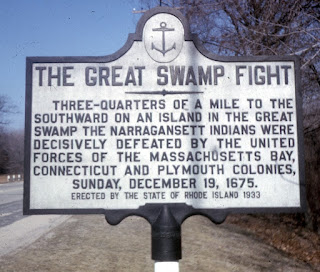
Caleb was of Barnstable when in 1675 he served in King Philip’s War. He would have been in Captain Gorham’s company which lost 36 men in the Great Swamp Fight against the Narragansetts.  I have read that he served as selectman (1669) and constable (1685) in Barnstable, but I need to find sources.  

Sign at West Kingston, RI that has gone missing (source: hmdb.com)


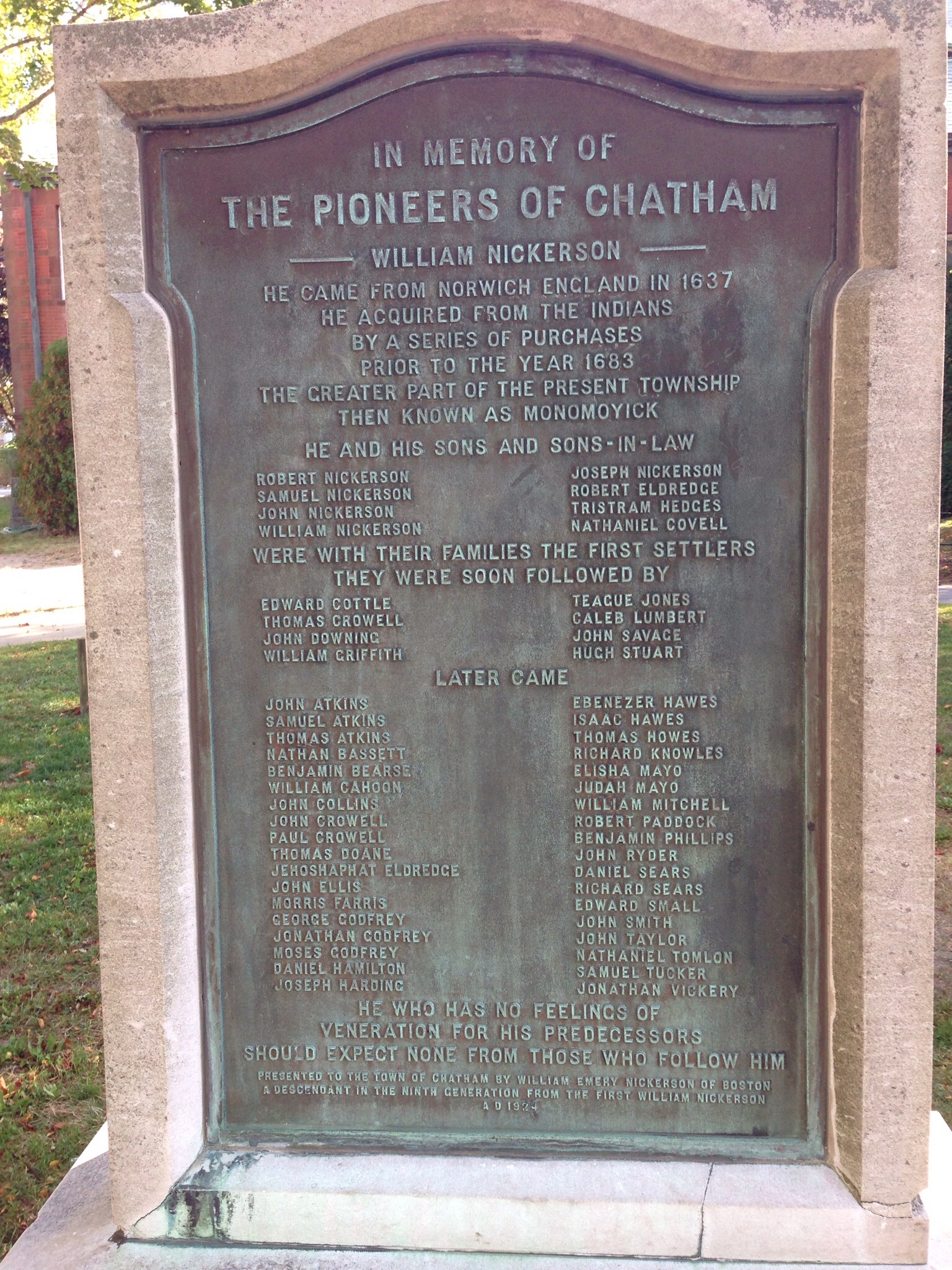
Caleb was an early settler of Chatham, (then Monomoit), Barnstable County, Massachusetts on Cape Cod, where he bought 40 acres of land shortly after 1681 and one of the first members of the church there. In Smith’s History of Chatham, he wrote Caleb had a fiery temper that at times put him at odds with neighbors. This could be what drew him to Chatham as there were others living there who bucked authority and likely relished settling a wild place far from the Plymouth government. Caleb was not the only family member who did things their own way…he illegally purchased Barnstable land from Indians on his [step?]mother’s behalf, and when authorities told her she could only keep one half of the land she refused, resulting in a legal contest.


Pioneers of Chatham Plaque


In December 1686 Caleb exchanged his Monomoit farm for a large tract at South Sea (now Harwichport) from Indians, likely another illegal purchase but no action was taken. In1687 he sold this land.


Caleb Lombard of New England was buried in Bridgetown, Barbados on 7 June 1692 [Burial Register of St. Michael’s Church]. It would be interesting to know if Caleb had relocated to Barbados, perhaps the reason he sold his Harwichport land in 1687.  It was common among men from coastal New England who traded lumber and salted fish for sugar and molasses to live at Bridgetown. Whether his wife was with him in Bridgetown also is not known.

Cathedral Church of St. Michael and All Angels, Bridgetown (source: Wikipedia)


Although records about Caleb are sparse, what I have found paints an interesting picture of him as an independent, adventurous man who scoffed at laws when they did not suit his purpose!


Sources:

Register, “First Settlers of Barnstable,” July 1848, page 314

Plymouth Colony Wills and Inventories,” Mayflower Descendant, 16:124-6, 1914 (citing folio 24)

Robert S. Wakefield, The American Genealogist,  “The Lombard Family of Barnstable, Mass.,” 1976, 52:136-139

Henry B. Hoff, NEHGS Nexus,  “New Englanders in the West Indies,” vol. XIV, No. 5, page 154

David Hamblen (communicated by) Register, “First Settlers of Chatham, Mass.” January 1853, 7:82

William C. Smith, History of Chatham, Mass., 1905

Eugene Stratton, Plymouth Colony, It's History and People, 1986

G. Andrew Moriarty Jr.. Register, “Barbadian Notes,” 67:370, October 1913

Susan Roser, Early Descendants of Henry Cobb of Barnstable, Massachusetts, Friends of the Pilgrim Series, Volume 1, 2008

Barnstable Massachusetts Town Records, 1640-1793, Volume 1 1640-1713, www.americanancestors.org [original manuscript at NEHGS Boston]

Robert Charles Anderson, The Great Migration Begins, 1995

George M. Bodge, Soldiers in King Philip’s War: being a critical account of that war, with a concise history of the Indian wars of New England from 1620-1677, 1896