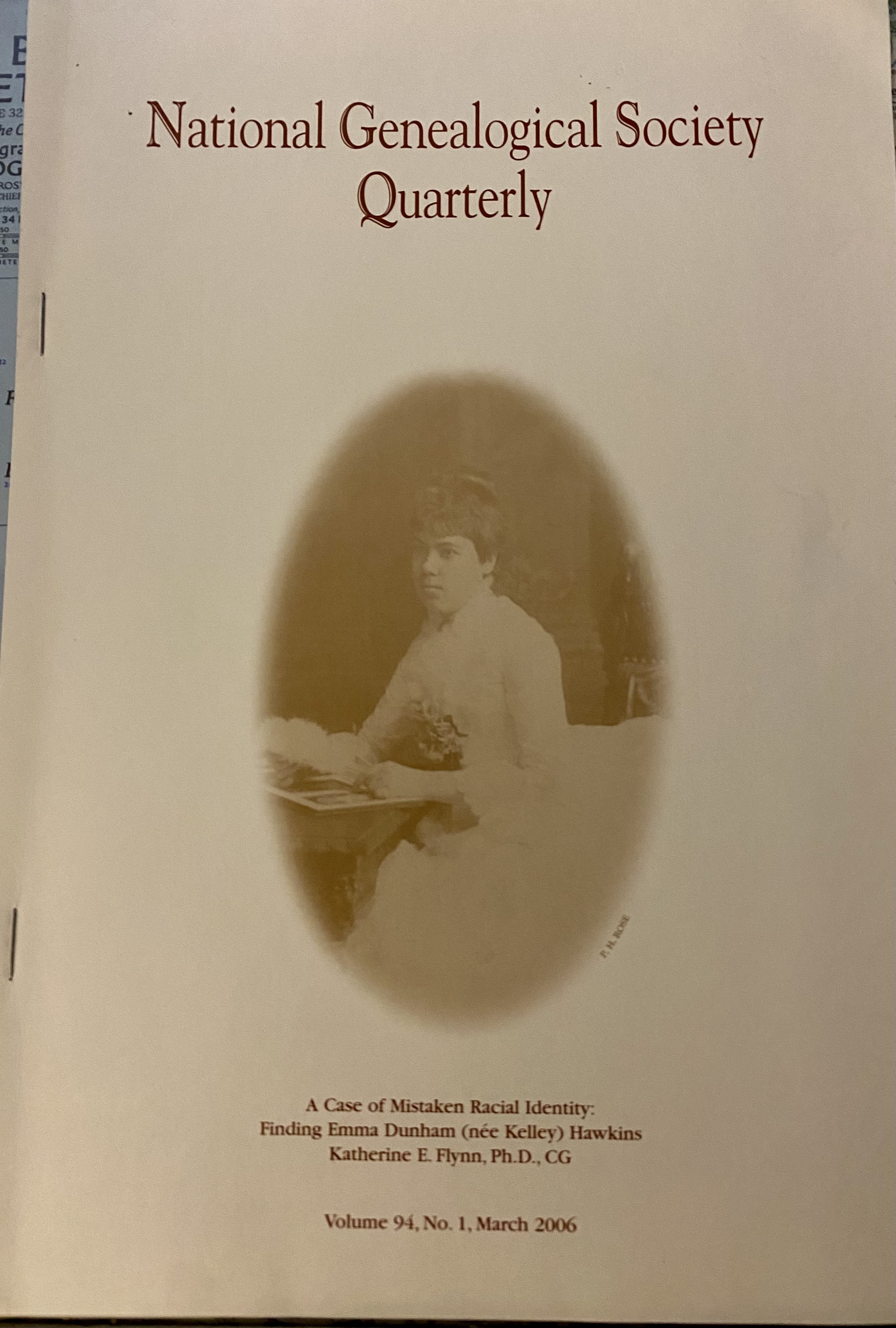
This isn’t my usual post as Emma Dunham Kelley Hawkins is not in my direct line—she is my first cousin, three times removed. I had basic information on Emma since the early days of my esearch. She was born Emma Dunham Kelley on 11 November 1863 at Dennis on Cape Cod, the daughter of Isaac Dunham and Gabrelia (Chase) Kelley (Dennis VR vol 3, p 1061).
Emma’s Misidentification
In 2003 I was contacted by Dr. Katherine “Kathy” Flynn who was researching the ancestral lines of Emma Kelley Hawkins. She informed me that Emma had been identified as one of the first important African American female writers! This was quite a surprise as I am certain that Emma was white. The goal of Flynn’s project was to reveal this error in Emma’s racial identification. Flynn’s work inspired me to do more research on Emma and when I recently came across her books while rearranging a bookshelf, I realized I had never compiled that information into a sketch on Emma.
According to Flynn’s research, the assumption she was black seems to be based solely on a photograph of her on the frontispiece of her novel Megda. Perhaps a contributing factor was that Cottage City that she wrote about is part of the area on Martha’s Vineyard known as Oak Bluffs, historically a popular resort area for black people.
 |
| Emma's photograph from Magda |
Emma’s Family
Emma’s father, Isaac, was the older brother of my great-great grandfather David Howes Kelley, a family I have thoroughly researched. Isaac was born in West Dennis 7 Apr 1839, the son of Hiram and Abagail (Howes) Kelley. (Dennis Vital Records 1: 230) At age 21 he married 18-year-old Gabrelia Chase at Dennis on 21 April 1859. (Dennis Vital Records 2:917) Gabrelia was the daughter of Warren and Emeline (Baker) Chase of South Dennis.
Isaac was only 23 when he tragically died at sea on 4 April 1863. (Dennis Vital Records 3:1423) He left behind three-year-old Alice May and his wife Gabrelia who was pregnant with Emma who would be born on 11 November. (Dennis Vital Records 3:1061) Did Isaac even know he was going to be a father again? Also on board were two of his brothers-in-law, Hersey Crowell (32 and married to Gabrelia’s sister Charlotte) and Johial Chase (Gabrelia’s 19 year old brother), so it was an unspeakably sad day for the family. They were on board the schooner Roxbury, delivering a cargo of ice from Boston to Virginia, when they sailed into a storm off the coast of Rhode Island and were never heard from again.
Gabrelia’s father, Warren Chase, was a sea captain who died in 1854 in Savannah’s yellow fever epidemic, according to his great-grandson E. Butler Moulton. With that 1863 storm, the male wage earners in the once prosperous Chase family were gone. Flynn put me in touch with Mr. Moulton who was elderly at time. We wrote each other letters and much of the personal information about the family comes from him.
Within two years of Isaac’s death, Gabrelia and her young daughters were living in New Bedford with her sister Emily Bryant’s family. (1865 Massachusetts State Census)
Gabrelia was 26 when she married, second, William Smith Quincy on 5 June 1867 at New Bedford, Mass. (Massachusetts Vital Records 1841-1910, 199:118) He was a carpenter, age 27, born in Portsmouth, Rhode Island, to Charles and Eliza Quincy. Remarkably it was also the second marriage for William.
Hopefully it was a love match for Gabrelia, but it did not last. William died in July 1868 of consumption, just a year after their marriage. He is buried at Christ Church Cemetery, Lincoln, Rhode Island. (Findagrave.com, Memorial ID 142759196) Gabrelia was once again left to raise her children alone, which now included a son, Herbert Quincy, born in January 1868. Gabrelia never married again.
 |
| Emma as a young woman from my family collection of photographs |
In 1875 Gabrelia Quinzy [sic] and her daughters Alice Kelley age 15, Emma Kelley age 11, and son Herbert Quinzy age 7, are living on Lonsdale Street in Cumberland, Rhode Island. Her mother Emeline Chase is living next door, taking in boarders, and her unmarried children Lavina and Warren are living with her. Many in the family worked at the Lonsdale Cotton Mill and lived in mill-owned row houses. (1875 Rhode Island State Census)
Gabrelia had moved to Cumberland, Rhode Island by 1880, when she is enumerated as “Gela” Quincy, 39, widowed, working in a cotton mill. With her are her children Alice Quincy, 20, working in cotton mill, Emma Quincy, 16, in school, and son Herbert Quincy, age 12, in school. Nearby were Emma’s aunts and uncles: Charlotte Crowell (widow of Captain Hersey Crowell), Warren, Abbie and Lavina Chase. (1880 Federal Census) The two sisters took different paths: Alice labored in a mill while, according to family information, Emma became a school teacher. I do wonder if they each had a choice in that path.
Emma and her family are always described as white in census and vital records. Some English settlers married Native Americans, but there were very few people of African origins on Cape Cod at the time Emma was born. A wave of Azorean immigrants didn’t arrive until the late 1800s. Flynn’s research shows that 99.6 percent of the residents enumerated from 1790 to 1865 in Emma’s four ancestral towns were white. There were early English settlers who married Native Americans, and some people believe that is the case with Emma’s ancestor William 2 Chase (born ca 1627 the son of William and Mary Chase; died February1685) but this is not possible to prove with traditional records. Many of the early Cape Cod families are interwoven—William 2 Chase is also my 9th great-grandfather and many married couples including Gabrelia and Isaac were also distant or not-so-distant cousins.
Emma As A Writer, Wife, Mother
Amongst considerable sadness and hardship, when Emma was in her 20s she published two novels:
- Megda, 1891, by Emma Dunham Kelley (her pen name was Forget-Me-Not). This book has her photograph in the frontispiece. It was so popular it was re-printed the following year.
- Four Girls in Cottage City, 1895, by Emma Kelley-Hawkins. This gave me the first indication that Emma had married and also a range of when that marriage took place.
Emma dedicated Megda to her mother: “To my widowed mother to whose patient love and unwearied devotion during years of hard struggle and self-sacrifice I owe all that I am and all that hope holds before me in the future.” I’m so glad in a life full of sorrow, Gabrelia had a daughter to be so proud of and was able to witness her success.
Emma actually included the story of her father’s tragic death in Four Girls, writing from her mother’s perspective of losing her husband “Isaac Chase.” Two passages from the book:
“At no time had I questioned God's goodness as I did then. I was wild with hopeless misery. They went away one cloudy day in the last of March. That night a terrible storm came up. I lay awake all night and listened to it. I loved my husband, but I worshipped my brother Jo. Was this the reason that God saw fit to take him from me? It was just and right for Him to do so, for I loved Jo better than I loved God. Our boys never came back to us. The storm swept them away from the face of the earth, and we saw them no more only a wreck was left off the coast of Cape Hatteras to tell us of the end they had made.”
“Oh those were terrible days! I have often wondered how we ever lived through them. I have known since where mother went to find strength to endure, and found it; but then my heart was hard and bitter. I think the suspense was the hardest, the most trying. It was hard to lose husband and brother together, yes, two brothers, for Hersey was very near to me. Seven months after the storm, another little girl was born to me, and when I heard its first little wailing cry, I turned my face to the wall and the tears rolled down my cheeks. Poor little baby! Never in this world to look upon its father's face! Why was it born? Then something in my heart seemed to give way. I gathered the tiny form close to me and kissed it and cried over it. And from that hour I loved it more than anything I had ever loved before except Jo.”
The writing seems melodramatic, typical of that time period, but when the reader knows the real story it is bone chilling.
 |
| A photograph of Emma where her skin appears lighter |
When Emma was 29, she married childless widower Benjamin Hawkins, a civil engineer who was eleven years her senior. Mr. Moulton said their 1892 wedding notice in the Pawtucket Valley Daily Times mentioned Emma as the author of Megda. He said this was not a love match, but one of practicality. Emma bought significant funds she earned from her first novel to the marriage, but her husband squandered the money as he worked on several unsuccessful inventions including a more efficient stove that he called the Hawkins Heater. They lived in various towns in Rhode Island including Lincoln, Pawtucket, and Providence.
Emma had two daughters: Gala E (Gala was her mother’s nickname) born 3 March 1894 and Megda D born 12 March 1897. I love that she chose unique names!
In 1910 the family was living in Lincoln, Rhode Island. Benjamin, 57, is listed a president of an automobile agency. Emma is 46, Lola (an error for Gala) is 16, Medga is 13, and “Tabralia,” which should be Gabrelia, is living with them. (1910 Federal Census)
The family was living on Sanford Street in Pawtucket in 1915. Benjamin Hawkins is 62, an auto supplies salesman; Emma is 47; Gala is 21 and a bookkeeper; Megda is 17. (1915 Rhode Island State Census)
Five years later the family is living on Burlington Street in Providence. Benjamin Hawkins is 67, an inventor of a heater, Emma is 52, Gala is 25, and a bookkeeper, Megda is 22 and a stenographer. (1920 Federal Census)
Gabrelia Ann “Gala” Chase Kelley Quincy died 6 Sept 1924, at Lonsdale, Providence County, Rhode Island. She was 83 years old. She is buried back home in South Dennis, sharing a gravestone with her beloved brother Johial but of course it’s only a memorial to him. There is a photograph of her as well as her gravestone at Findagrave.com, Memorial ID 148540852.
 |
| Photograph of Gabrelia and her gravestone source:Findagrave.com |
Mr. Butler said that even though Emma worked as a librarian at the Davis Circulating Library in Pawtucket to supplement her husband’s erratic income, the family still lost their first home to foreclosure and moved from one affordable rental to another.
Emma as an Older Adult
Emma wrote her will in April 1929 and Mr. Butler said that out of concern for the financial well being of her unmarried daughters, she stipulated Benjamin was not to receive a penny from her estate. (File no 3472, Probate Court, East Providence RI)
Benjamin predeceased Emma, dying of heart disease in November 1929. Times were tough financially for Emma during the Depression, although both of her daughters had good jobs as secretaries. Emma’s aunt Lavina Chase was the last of her family and since she never married, she left most of her estate to Emma when she died in 1933. Emma was able to purchase a home and live comfortably for the final five years of her life.
 |
| If house numbers are the same, this is Emma's home at 104 Center St., Rumford |
In 1930 Emma is living on Brown Street in Providence, age 60, a widow. Her daughter Gala is 30, single, a private secretary. Daughter Medga is 27, single, and impressively a head clerk with the Attorney General’s Office. (1930 Federal Census)
Emma died, also of heart disease, at home on 104 Centre Street, Rumford (the northern section of East Providence, Rhode Island) on 22 October 1938. She was 74 years of age. She is buried at Moshassuck Cemetery in Central Falls, next to her husband and daughters.
 |
| The Hawkins Family Gravestone source:Findagrave.com |
Emma’s Identification as a Black Writer
Both of Emma’s books were reprinted in the 1988 Schomburg Library of Nineteenth-Century Black Women Writers. The project was under the direction of Henry Louis Gates, Jr., a Harvard University Professor and host of the PBS genealogy show Finding Your Roots.
I have read both of Emma’s books. The plots center on young Christian women who seem to lead God-fearing yet still carefree lives, and in the second novel they are vacationing on Martha’s Vineyard. That Emma’s mother made sure Emma was well-educated is shown through her talent as a writer and her mentioning he literary work of writers such as Dickens and Longfellow in her novels.
I shared genealogical information I had found with Flynn and we corresponded for some time. In her research, Flynn found that the idea of Emma being black came about in 1955 when she was included in A Century of Fiction by American Negros 1853-1952: A Descriptive Bibliography by Maxwell Whiteman who assumed Kelley-Hawkins was of African descent based on her photograph in Megda, classifying her as a “Negro author.” This identification of her as black was unquestioned for 50 years.
In Emma’s books there is no indication of the challenges facing black women at that time and they contain no political or social protest statements, and many characters in the books are described as having skin as white as snow, blonde hair, and blue eyes. It seems so strange to me that scholars never questioned her racial identity in all those years. Laziness and making assumptions is not exactly top-notch scholarship.
It turns out Flynn wasn’t the only scholar studying this case of mistaken identity. On 20 February 2005, The Boston Globe published an article by doctoral student Holly Jackson entitled “Mistaken Identity: What if a Novelist Celebrated as a Pioneer of African American Women’s Literature Turned Out Not to be Black at All?”
Jackson did extensive research on Emma and her ancestors. She found that in four generations, over the course of 80 years, every single member of her family identified as white. She found that Oak Bluffs as a black resort destination did not extend as far back as the 1890s when Emma’s novels were published. Before the 20th century, blacks on Martha’s Vineyard were more likely to be domestic workers than vacationers.
Flynn published her findings as “A Case of Mistaken Identity: Finding Emma Dunham (nee Kelley) Hawkins,” National Genealogical Society Quarterly, 94:1 (March 2006). She graciously acknowledged me for sharing my family story.
Henry Louis Gates told reporter David Mehegan in the latter’s article “Correcting a case of mistaken identity,” that he was persuaded Emma was not black and her books would be removed from the next edition of the Schomburg series. Gates said of Emma’s photograph: “You put that picture up in my barbershop, and I guarantee the vote would be to make her a sister.” He pointed out he wasn’t the one to first identify Emma as black and he takes no accountability for the error of including her in a series he edited. (The Boston Globe, 5 March 2005)
Emma’s Children and Siblings
Emma’s daughters inherited their mother’s house at 104 Center Street in Rumford. Gala died there in 1953 at age 59. Gala lived to age 87. They are both buried with their parents. (Gala: findagrave.com Memorial ID 15868303; Magda: ID 15868305) Neither of Emma’s daughters married or had children. Mr. Moulton said they were passionate about women’s rights.
 |
| Possibly Megda and Gala Hawkins from my collection of family photos |
I was curious what became of Emma’s siblings, so did some research. Her sister Alice May Kelley was born 5 Dec 1859 in Dennis. She married Charles Ephraim Meader (1856-1929) on 6 October 1880 in Cumberland, Rhode Island. She had a daughter Mildred born 23 July 1883 in Lincoln, Rhode Island. Her daughter Charlotte May Meader was born 23 April 1886 in Saylesville, Rhode Island. Again—two daughters! She died 15 April 1932 at age 72 and is also buried at Moshassuck Cemetery in Central Falls.
 |
| Alice May Kelley Meader's gravestone |
Her half-brother Herbert Quincy was born 17 Jan 1868 at New Bedford., Mass. He married Mary Lee Carter in 1893. They had a son Earl born May 1894. He lived in Pawtucket, Rhode Island as an adult, renting or living in his brother-in-law’s home. He worked as a teamster, a driver for a bakery, a salesman for a printing company, and in a cotton factory. Herbert died 5 Jan 1947 in Pawtucket at age 78. He is also buried Moshassuck Cemetery.
 |
| Herbert Hawkins' gravestone |
Conclusion
Although Emma was not a trailblazing black writer, she was a published author at a time when that was rare for working-class women. And more importantly, she was a survivor and her writing revealed her to be a moral, family-oriented, religious woman. My great-grandmother Ethel Kelley Booth was Emma’s first cousin and she kept photographs of Emma and who I believe are Emma’s daughters. Hopefully Emma’s family returned to Dennis for visits, where my great-grandmother Ethel grew up and it seems they continued corresponding, sending photographs. Ethel was a voracious reader, so I like to think that she had Emma’s books in her collection. Ethel’s father, David Howes Kelley, started out as a mariner but changed to work in various jobs on land. Perhaps if he did not turn from the sea, Ethel would have had a tragic Mary life mirroring her cousin Emma.
 |
| Photograph from my great-grandmother's collection like bears a likeness to Emma |